The Most Dominant Ever
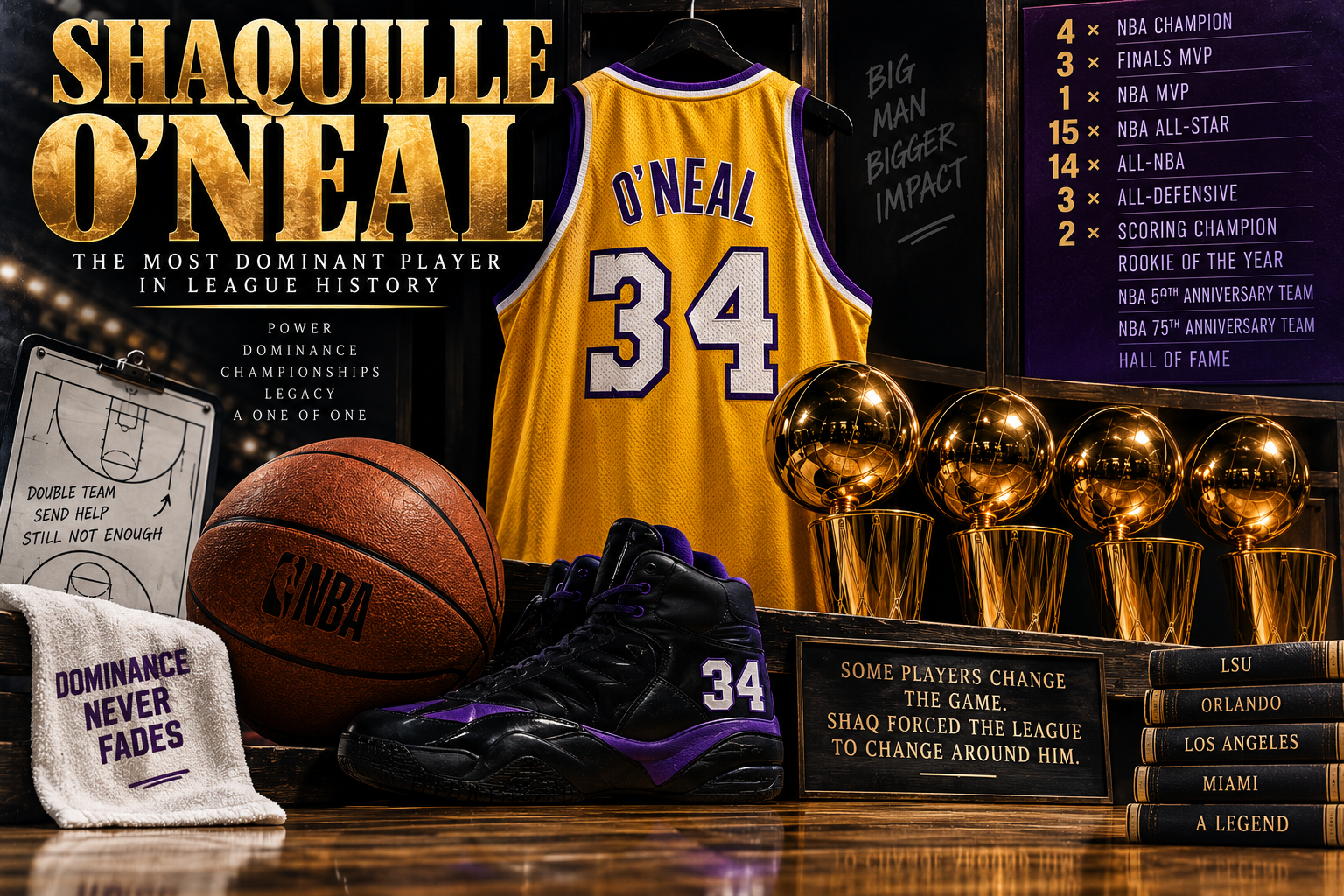
Shaquille O’Neal was the most dominant player in NBA history. Not the most skilled, not the greatest shooter and not the greatest player overall. The most dominant.
At his peak, there simply wasn’t an answer for Shaq. You could double him, foul him, throw another seven-footer at him or build an entire defensive game plan around stopping him. Most nights, none of it mattered. Shaq was too big, too strong and somehow far too athletic for a man his size.
Peak Shaq looked like someone had created a player in a video game and turned every physical attribute to 99.
From LSU to Orlando
Shaq became a superstar before he ever stepped onto an NBA court. At LSU, his combination of size, strength and athleticism made him one of the biggest prospects basketball had seen, and the Orlando Magic selected him with the first overall pick in the 1992 NBA Draft.
The impact was immediate. Shaq averaged 23.4 points, 13.9 rebounds and 3.5 blocks per game as a rookie, earning Rookie of the Year and becoming an All-Star in his first season.
Orlando had only existed as an NBA franchise since 1989. By Shaq’s third season, they were playing in the NBA Finals.
Hakeem Stops the Young Superstar
Shaq and Penny Hardaway led Orlando to the 1995 NBA Finals, where they met the defending champion Houston Rockets and Hakeem Olajuwon.
Houston swept Orlando 4-0. Shaq still averaged 28.0 points, 12.5 rebounds and 6.3 assists in the series, but Hakeem and the Rockets were simply better. For a 23-year-old Shaq, it was his first experience on basketball’s biggest stage.
It wouldn’t be his last.
Hollywood
In 1996, Shaq left Orlando and signed with the Los Angeles Lakers. That same summer, the Lakers acquired a teenage Kobe Bryant. It would eventually create one of the greatest duos basketball has ever seen.
The talent was obvious, but championships didn’t arrive immediately. Los Angeles kept falling short in the playoffs until Phil Jackson took over before the 1999-2000 season.
Then Shaq reached his absolute peak.
The 2000 MVP
The 1999-2000 season was Shaquille O’Neal at his most terrifying. He averaged 29.7 points, 13.6 rebounds and 3.0 blocks per game, won the scoring title and was named NBA MVP.
He received 120 of 121 first-place MVP votes, falling one vote short of becoming the first unanimous MVP in league history.
The Lakers survived a seven-game Western Conference Finals against Portland before meeting the Indiana Pacers in the NBA Finals. Shaq absolutely destroyed them.
He averaged 38.0 points and 16.7 rebounds per game in the Finals as Los Angeles won the championship in six games. Shaq was named Finals MVP, completing one of the greatest individual seasons the league has ever seen.
And he was only getting started.
Three Straight
The Lakers came back in 2001 and ripped through the playoffs. Los Angeles went 15-1, with its only loss coming in overtime against Allen Iverson and the Philadelphia 76ers in Game 1 of the NBA Finals.
Shaq responded by helping the Lakers win the next four games. He averaged 33.0 points and 15.8 rebounds in the Finals and collected his second straight Finals MVP.
Then they did it again in 2002. Los Angeles swept the New Jersey Nets in the Finals, with Shaq averaging 36.3 points and 12.3 rebounds. Another championship. Another Finals MVP.
Three consecutive championships. Three consecutive Finals MVPs.
For three straight years, everyone knew exactly where the Lakers wanted to go with the basketball. Nobody could stop it.
Six Extra Fouls
Shaq’s dominance changed the way teams constructed their rosters. Opponents needed size simply to survive against him, and teams would carry big men whose primary job was essentially to absorb fouls while trying to keep Shaq away from the basket.
You weren’t stopping Shaq. You were just hoping you had enough bodies to foul him.
The famous Hack-a-Shaq strategy existed because intentionally sending a superstar to the free-throw line was sometimes considered a better option than allowing him to catch the ball near the rim. Shaq was a career 52.7% free-throw shooter, and it became the obvious weakness teams tried to exploit.
The fact that deliberately fouling him became a legitimate defensive strategy tells you everything about how impossible he could be to guard normally.
Shaq and Kobe
The Lakers dynasty wasn’t without problems. Shaq and Kobe’s relationship became increasingly difficult, and after Los Angeles lost the 2004 NBA Finals to the Detroit Pistons, the partnership finally ended.
Shaq was traded to the Miami Heat.
Even with the way it ended, what Shaq and Kobe accomplished together cannot be ignored. They won three straight championships and became one of the defining duos in NBA history.
But Shaq wasn’t finished winning.
One More Ring
In Miami, Shaq joined a young Dwyane Wade and immediately helped turn the Heat into a championship contender. Two years after arriving, Miami reached the 2006 NBA Finals against the Dallas Mavericks.
By then Wade had become the team’s superstar, but Shaq remained an important piece in the middle as Miami came back from a 2-0 series deficit to win four straight games and capture the first championship in franchise history.
For Shaq, it was championship number four.
A One-of-One Career
By the time Shaq retired in 2011, he had put together one of the greatest résumés ever assembled by a center:
- 4× NBA Champion
- 3× Finals MVP
- 1× NBA MVP
- 15× NBA All-Star
- 14× All-NBA
- 3× All-Defensive
- 2× NBA Scoring Champion
- 1992-93 Rookie of the Year
- NBA 50th Anniversary Team
- NBA 75th Anniversary Team
- Basketball Hall of Fame
Shaq finished his career with 28,596 points and 13,099 rebounds, averaging 23.7 points and 10.9 rebounds per game across 19 NBA seasons. But the career averages don’t fully capture what peak Shaq looked like.
From 2000 through 2002, he stood at the center of a dynasty and walked away from all three Finals holding the same trophy.
Finals MVP. Finals MVP. Finals MVP.
That’s the Shaquille O’Neal I think of when I call him the most dominant player in league history. Teams knew what was coming. Coaches designed entire game plans around stopping it. Rosters were built with extra size just to deal with him.
It still wasn’t enough.
On our list of the five greatest centers in NBA history, Shaquille O’Neal comes in at number three.
Like the article and subscribe to Ethical Sports Takes for more NBA rankings, stories and sports coverage.
Leave a Reply