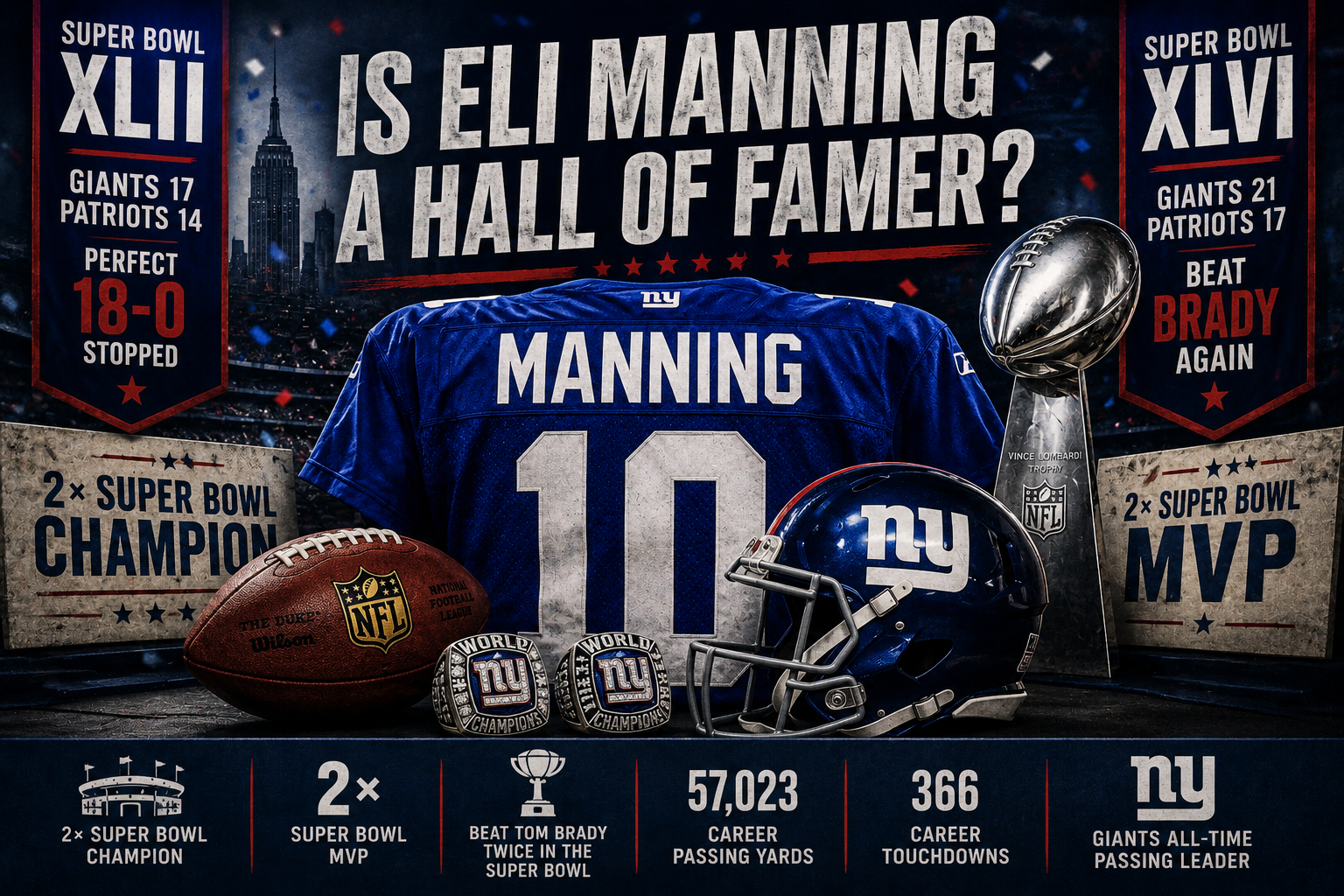
Simply put, ABSOLUTELY.
Whenever Eli Manning’s Hall of Fame case comes up, the same argument is usually made against him: his regular season résumé was never dominant enough.
And sure, Eli wasn’t Peyton Manning, Tom Brady or Aaron Rodgers during the regular season. He never won an MVP. He never made First Team All Pro. He finished his career with a perfectly balanced 117 wins and 117 losses as a starter.
But acting like Eli accomplished nothing during the regular season isn’t exactly fair either.
Manning made four Pro Bowls, threw for 57,023 yards and 366 touchdowns, and started 210 consecutive games at one point in his career. When he retired, he ranked seventh in NFL history in both passing yards and passing touchdowns. He also finished as the Giants’ all time leader in essentially every major passing category.
Those aren’t bad numbers for a guy whose regular season career supposedly disqualifies him from Canton.
But let’s get to the real reason Eli Manning belongs in the Hall of Fame.
We watch football for the biggest moments.
And when Eli Manning got his opportunities on the biggest stage, he delivered something most quarterbacks in NFL history could only dream of accomplishing.
Eli Manning went 2 and 0 in the Super Bowl and won Super Bowl MVP both times.
The first run came after the 2007 season.
The New England Patriots entered Super Bowl XLII at 18 and 0. They were one victory away from completing the first 19 and 0 season in NFL history. Tom Brady had just won MVP, New England had one of the greatest offenses football had ever seen, and almost nobody expected the Giants to be the team that stopped them.
Eli Manning stopped them.
With the Giants trailing late in the fourth quarter, Manning escaped what looked like a certain sack and completed one of the most famous passes in NFL history to David Tyree. A few plays later, Manning found Plaxico Burress for the game winning touchdown.
Giants 17. Patriots 14.
The perfect season was dead.
Eli Manning was a Super Bowl champion and Super Bowl MVP.
If that had been his only magical postseason run, maybe there would be more room for debate.
Then he did it again.
Four years later, the Giants entered the postseason at just 9 and 7. Once again, they weren’t supposed to make a championship run.
Manning proceeded to lead New York through four consecutive playoff victories. During that run, the Giants went on the road and beat the 15 and 1 Green Bay Packers, then went into San Francisco and defeated the 49ers in the NFC Championship Game.
Waiting for him in the Super Bowl?
Tom Brady and the New England Patriots.
Again.
And Eli beat them again.
Manning threw for 296 yards, completed 30 of his 40 passes and led the Giants on the championship winning drive late in the fourth quarter. His throw to Mario Manningham down the sideline remains one of the greatest passes in Super Bowl history.
Two championships.
Two Super Bowl MVPs.
Two victories over Tom Brady and Bill Belichick.
One of them ended an 18 and 0 season.
How many quarterbacks have put together fantastic regular season statistics only to repeatedly fall short when January arrives?
We criticize those quarterbacks for failing in the postseason. So why would we suddenly decide the postseason doesn’t matter when evaluating Eli Manning?
There are quarterbacks with better completion percentages.
There are quarterbacks with more Pro Bowls.
There are quarterbacks with MVPs and All Pro selections that Eli never earned.
But there are very few quarterbacks in the history of football who wouldn’t trade some of those individual accomplishments for what Eli Manning accomplished during those two postseason runs.
The Hall of Fame shouldn’t simply be a statistics counter.
It shouldn’t be a Pro Bowl counter.
The Hall of Fame exists to preserve the careers of players who left a permanent mark on the history of professional football.
And ask yourself one simple question:
Can you seriously tell the story of the NFL without Eli Manning?
How do you tell the story of the 2007 Patriots without Eli?
How do you tell the story of arguably the greatest upset in Super Bowl history without Eli?
How do you tell the story of the Brady and Belichick dynasty without mentioning that the same quarterback defeated them in two separate Super Bowls?
You can’t.
Eli Manning’s career wasn’t perfect. His regular season résumé doesn’t compare to the greatest quarterbacks who have ever played. A 117 and 117 record isn’t going to blow anybody away.
But the moments that defined his career are among the most important moments in NFL history.
When the lights were brightest and the stakes were highest, Eli Manning delivered.
Twice.
Is Eli Manning a Hall of Famer?
Absolutely.
Put him in Canton.
Leave a Reply