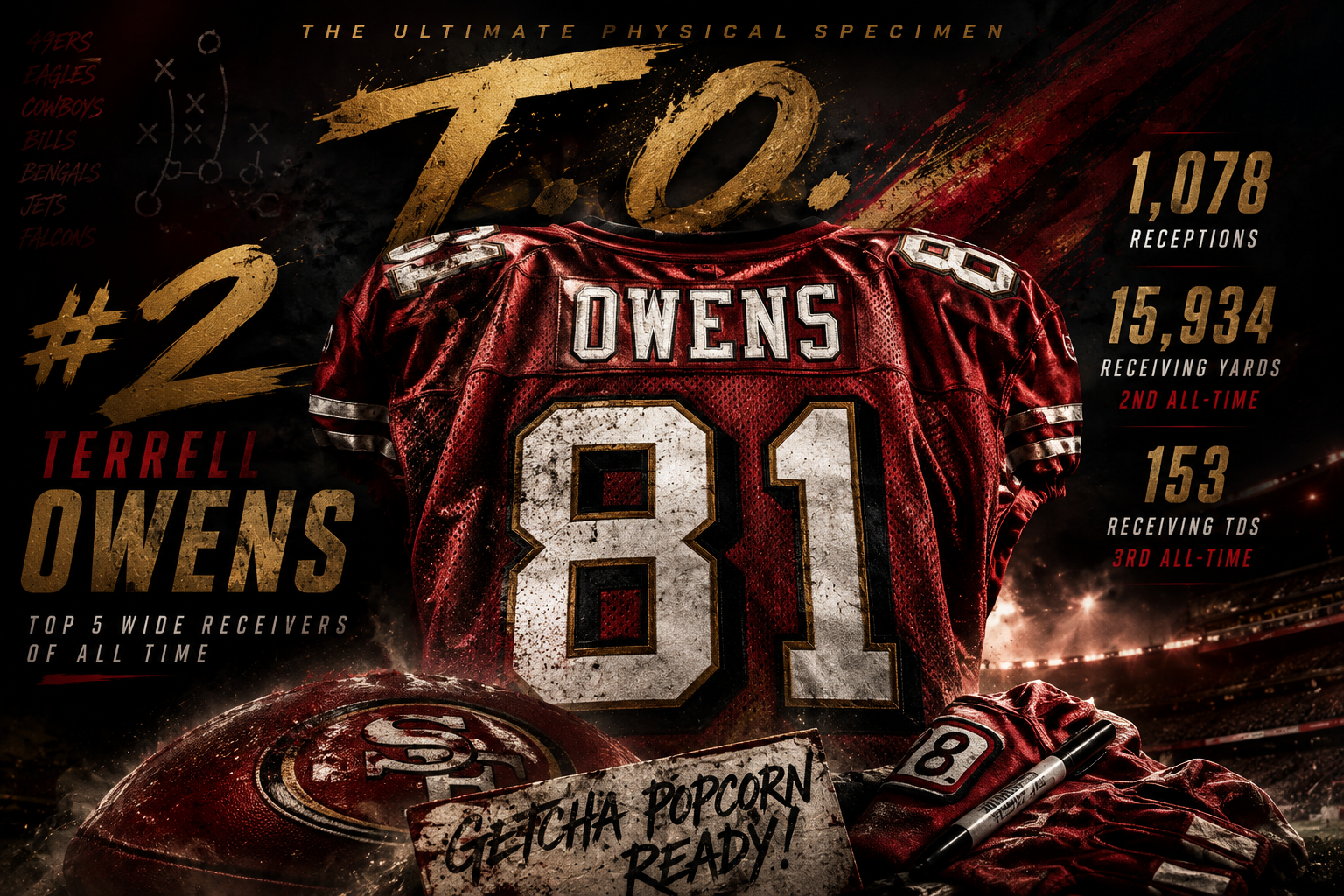
When talking about the greatest wide receivers in NFL history, very few players have ever combined size, strength, speed, athleticism and production quite like Terrell Owens. T.O. was not just a great receiver; he was a physical nightmare. At 6-foot-3 and around 225 pounds, Owens had the strength to overpower defensive backs, the speed to beat them downfield and the explosiveness to turn a short completion into a touchdown. Once he got the football in his hands, bringing him down became somebody else’s problem, and for nearly two decades NFL defenses had plenty of problems trying to stop him.
From Chattanooga to the NFL
Before becoming one of the most recognizable players in professional football, Owens played at the University of Tennessee at Chattanooga from 1992 through 1995. By the time he left, Owens had compiled 144 receptions for 2,320 receiving yards and 19 touchdowns, averaging an impressive 16.1 yards per reception for his college career. He led Chattanooga in receiving during each of his final three seasons and earned First-Team All-Southern Conference honors as a senior.
Football was not even the only sport showcasing his athleticism. Owens also competed for Chattanooga’s basketball and track and field teams, giving an early indication of the kind of all-around athlete NFL defenses would eventually have to deal with.
Despite his production and physical gifts, Owens was not one of the highly celebrated prospects taken at the top of the 1996 NFL Draft. The San Francisco 49ers selected him in the third round with the 89th overall pick.
Safe to say they found themselves a pretty good third-round pick.
From San Francisco to NFL Stardom
Owens entered the NFL in 1996 and immediately found himself in perhaps the greatest situation imaginable for a young wide receiver. He joined a San Francisco receiver room featuring Jerry Rice, the greatest wide receiver of all time, giving T.O. the opportunity to learn alongside the standard every receiver after him would be measured against.
But it did not take long for Owens to establish an identity of his own. As Rice’s legendary career in San Francisco approached its end, T.O. emerged as the next great 49ers receiver.
Think about what that meant. The 49ers believed so strongly in Terrell Owens that they were willing to move forward without Jerry Rice — the greatest wide receiver of all time — and make T.O. the centerpiece of their passing attack. Let that sink in. San Francisco had the greatest receiver the sport had ever seen, and the player waiting behind him was so special that the franchise was comfortable beginning a new era with Owens as its number one weapon.
And T.O. proved they had every reason to believe in him. His combination of physicality and explosiveness made him one of the most dangerous offensive weapons in football. Owens could win deep, dominate after the catch and use his size in situations where smaller defensive backs simply had no answer. By the early 2000s, he was not merely Jerry Rice’s successor in San Francisco. He was a superstar in his own right.
From 2000 through 2002, Owens produced one of the greatest three-year stretches of his career, catching 290 passes for 4,163 yards and 42 touchdowns. His dominance continued throughout the decade, eventually earning him a place on the NFL’s All-Decade Team of the 2000s.
Think about the receivers who played during that era: Randy Moss, Marvin Harrison, Torry Holt and several other all-time greats. T.O. did not merely play during one of the greatest eras of wide receiver talent in NFL history. He was recognized as one of the defining receivers of the entire decade.
Production That Places Him Among the Greatest Ever
Terrell Owens’ career numbers do not simply look impressive on a stat sheet. When his NFL career ended, they placed him near the very top of the sport’s record books.
Owens finished with 1,078 receptions for 15,934 receiving yards and 153 receiving touchdowns. At the time his career ended, his 15,934 receiving yards ranked second in NFL history, trailing only Jerry Rice, while his 153 receiving touchdowns ranked third all-time.
Read that again.
After 15 seasons in the NFL, only one player in league history had accumulated more receiving yards than Terrell Owens, and only two had caught more touchdown passes. His 1,078 career receptions also placed him among the most prolific pass catchers the game had ever seen.
Those totals were not simply the product of hanging around for a long time, either. Owens recorded nine 1,000-yard seasons, reached double-digit receiving touchdowns eight times, earned six Pro Bowl selections and was named First-Team All-Pro five times. He also led the NFL in receiving touchdowns three separate times.
Even late in his career, T.O. continued producing. At 36 years old in his final NFL season with Cincinnati, Owens caught 72 passes for 983 yards and nine touchdowns in just 14 games. He finished only 17 yards short of another 1,000-yard season.
He also proved that his greatness was not tied to one quarterback, one coach or one system. Owens produced at an elite level with the 49ers, became a dominant weapon in Philadelphia and then, after turning 33 years old, went to Dallas and recorded three consecutive 1,000-yard seasons. Different teams and different quarterbacks kept producing the same result: T.O. dominating defensive backs.
The Personality Was Part of the Package
You could not really separate Terrell Owens the football player from Terrell Owens the entertainer. His celebrations became legendary, from standing on the Dallas Cowboys’ star to pulling a Sharpie from his sock after scoring a touchdown and eating popcorn after finding the end zone.
T.O. understood something long before social media completely changed professional sports: football was entertainment too. He brought personality, emotion and showmanship to the game, and when Terrell Owens was playing, you wanted to watch.
The Super Bowl Performance That Defined His Toughness
If there is one performance that captures why T.O. belongs this high on this list, it came on the biggest stage of his career. Late in the 2004 season, Owens suffered a serious leg and ankle injury that required surgery, putting his chances of returning for the Super Bowl in serious doubt.
He returned anyway.
Just seven weeks after suffering the injury, Owens suited up for the Philadelphia Eagles in Super Bowl XXXIX against the New England Patriots, and he did not simply make a ceremonial appearance. Owens caught nine passes for 122 yards against a Patriots team in the middle of a dynasty.
Philadelphia ultimately lost 24-21, but Owens had answered every question about whether he could perform when it mattered most. That night was bigger than a stat line. It showed exactly how badly Terrell Owens wanted to compete.
Why T.O. Is #2
There have been receivers with incredible hands, receivers with greater speed and receivers who ran cleaner routes, but finding someone who combined everything Terrell Owens possessed is much harder. He had elite production, longevity, size, speed, strength and the ability to take over games whether the defense knew the football was coming his way or not.
When ranking the greatest wide receivers to ever play football, the most important thing is what happened between the lines, and between the lines, Terrell Owens was one of the greatest to ever do it.
That is why T.O. comes in at #2 on my list of the five greatest wide receivers of all time.
There is only one man left.
And we all know who he is.
Enjoyed the article?
👍 Like this post if you enjoyed it.
🔔 Subscribe to Ethical Sports Takes so you don’t miss #1 in the Top 5 Wide Receivers of All Time and more sports stories, rankings and analysis.
Thanks for reading Ethical Sports Takes.
Leave a Reply