Before John Elway ever took an NFL snap, he was already viewed as one of the greatest quarterback prospects football had ever seen. At Stanford, Elway showed everything teams wanted from a franchise quarterback: a rocket arm, athleticism, mobility, toughness, and the ability to make throws very few quarterbacks could even attempt.
And his college production was ridiculous for the era. In four seasons at Stanford, Elway threw for 9,349 yards and 77 touchdowns, completing more than 62 percent of his passes. Remember, this was college football from 1979 through 1982, not the pass-heavy game we see today.
His senior season was particularly impressive. Elway threw for 3,242 yards and 24 touchdowns in just 11 games, finishing second in the Heisman Trophy voting. Stanford wasn’t some national powerhouse surrounding him with overwhelming talent either. Elway was the attraction.
He was also a legitimate baseball prospect and was selected by the New York Yankees in the second round of the 1981 MLB Draft. Elway wasn’t merely a great college quarterback. He was one of the most gifted athletes of his generation.
By the time the legendary 1983 NFL Draft arrived, there was little debate about his talent. Elway was selected first overall by the Baltimore Colts before eventually being traded to the Denver Broncos, beginning one of the greatest quarterback careers in NFL history.
Carrying Denver
When people look back at Elway’s career today, they see the two championships at the end. But what made his career special happened long before he finally lifted the Lombardi Trophy.
John Elway repeatedly took Broncos teams to the Super Bowl that had no business getting that far.
Denver reached three Super Bowls in four seasons during the late 1980s. Those teams weren’t loaded with the kind of offensive talent that surrounded many other legendary quarterbacks. Elway was often the engine that made everything work. His combination of arm strength, mobility, and late-game heroics gave Denver a chance in games where they otherwise might have been completely outmatched.
The defining example came in the 1986 AFC Championship Game against the Cleveland Browns. Denver trailed 20-13 and took possession at its own two-yard line with just over five minutes remaining. Elway proceeded to lead a 98-yard touchdown drive to tie the game.
It became known simply as The Drive.
Denver eventually won in overtime and advanced to the Super Bowl. It remains one of the defining moments of Elway’s career because it represented exactly what made him special. When Denver desperately needed something to happen, everyone knew who had to make it happen.
The Super Bowl Heartbreak
Getting Denver to the Super Bowl was one thing. Winning it proved much more difficult. Elway and the Broncos lost Super Bowls XXI, XXII, and XXIV, with each defeat becoming another part of the conversation surrounding his legacy.
It didn’t matter that Denver probably wouldn’t have reached several of those games without him. Quarterbacks are judged by championships, and as the years passed, the question became unavoidable.
Would John Elway ever win the big one?
The losses could have defined his career. Instead, they made what happened next even better.
Finally, a Champion
More than a decade after his first Super Bowl appearance, Elway returned to the biggest stage for Super Bowl XXXII against the Green Bay Packers. This time, he didn’t have to carry Denver by himself.
Terrell Davis delivered one of the greatest Super Bowl performances ever, rushing for 157 yards and three touchdowns. But Elway still produced one of the defining images of the game.
Facing third down in the third quarter, Elway scrambled toward the first-down marker and launched himself into the defense. He was hit by multiple Packers defenders and spun through the air like a helicopter while fighting for the yardage.
The play became known as The Helicopter, and it perfectly represented a quarterback who had spent his entire career refusing to quit.
Denver won 31-24. After three Super Bowl losses and years of waiting, John Elway was finally a Super Bowl champion.
The Perfect Ending
Most players would have been satisfied with finally getting one. Elway wasn’t finished.
The following season, Denver returned to the Super Bowl to face the Atlanta Falcons. This time Elway wasn’t simply along for the ride. At 38 years old, he threw for 336 yards and a touchdown, added another touchdown on the ground, and was named Super Bowl XXXIII MVP as Denver won 34-19.
Then he walked away.
No long decline. No bouncing between teams trying to hold onto his career. Elway’s final NFL game ended with him holding another Lombardi Trophy after winning Super Bowl MVP.
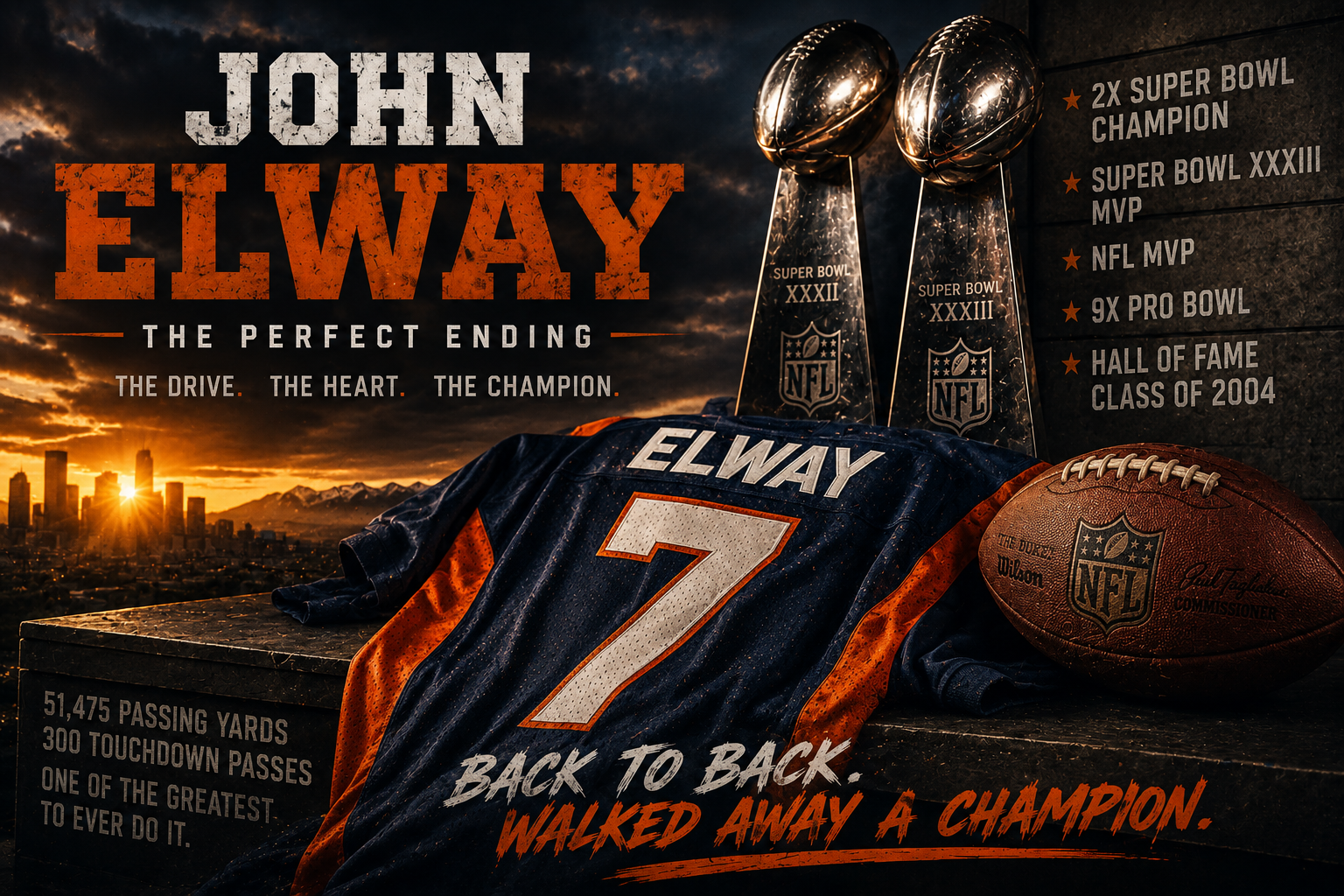
Back-to-back championships. Super Bowl MVP. Retirement.
It’s difficult to imagine a better ending.
The Legacy of John Elway
John Elway finished his career with 51,475 passing yards, 300 passing touchdowns, nine Pro Bowl selections, an NFL MVP award, and two Super Bowl championships. At the time of his retirement, he was near the top of virtually every major career passing category.
His place in NFL history goes beyond the numbers. Elway was selected to the NFL 1990s All-Decade Team and later to the NFL 100th Anniversary All-Time Team, placing him among the greatest players from the league’s first century. In 2004, he received the most obvious recognition of all when he was inducted into the Pro Football Hall of Fame in his first year of eligibility.
Those honors matter because Elway’s greatness can’t be completely captured by comparing his raw statistics with quarterbacks playing in today’s NFL. He played in a different era, and his contemporaries and football historians consistently placed him among the game’s elite.
Elway entered the NFL carrying enormous expectations and somehow lived up to them. He carried Denver teams deep into January that had no business reaching the Super Bowl, authored one of the greatest drives in NFL history, endured three painful Super Bowl defeats, and continued chasing the championship that had escaped him.
Then, when it looked like his opportunity might have passed, everything came together.
Some legends dominate from beginning to end. Others have to wait years for the moment that completes their story.
John Elway waited. And when his moment finally arrived, he didn’t win once. He won twice and walked away on top.
That’s why John Elway will forever be one of the legends of the game.
If you enjoyed this Stories of Legends article, make sure to like and subscribe to Ethical Sports Takes for more stories celebrating the athletes who helped shape sports history.
Leave a Reply