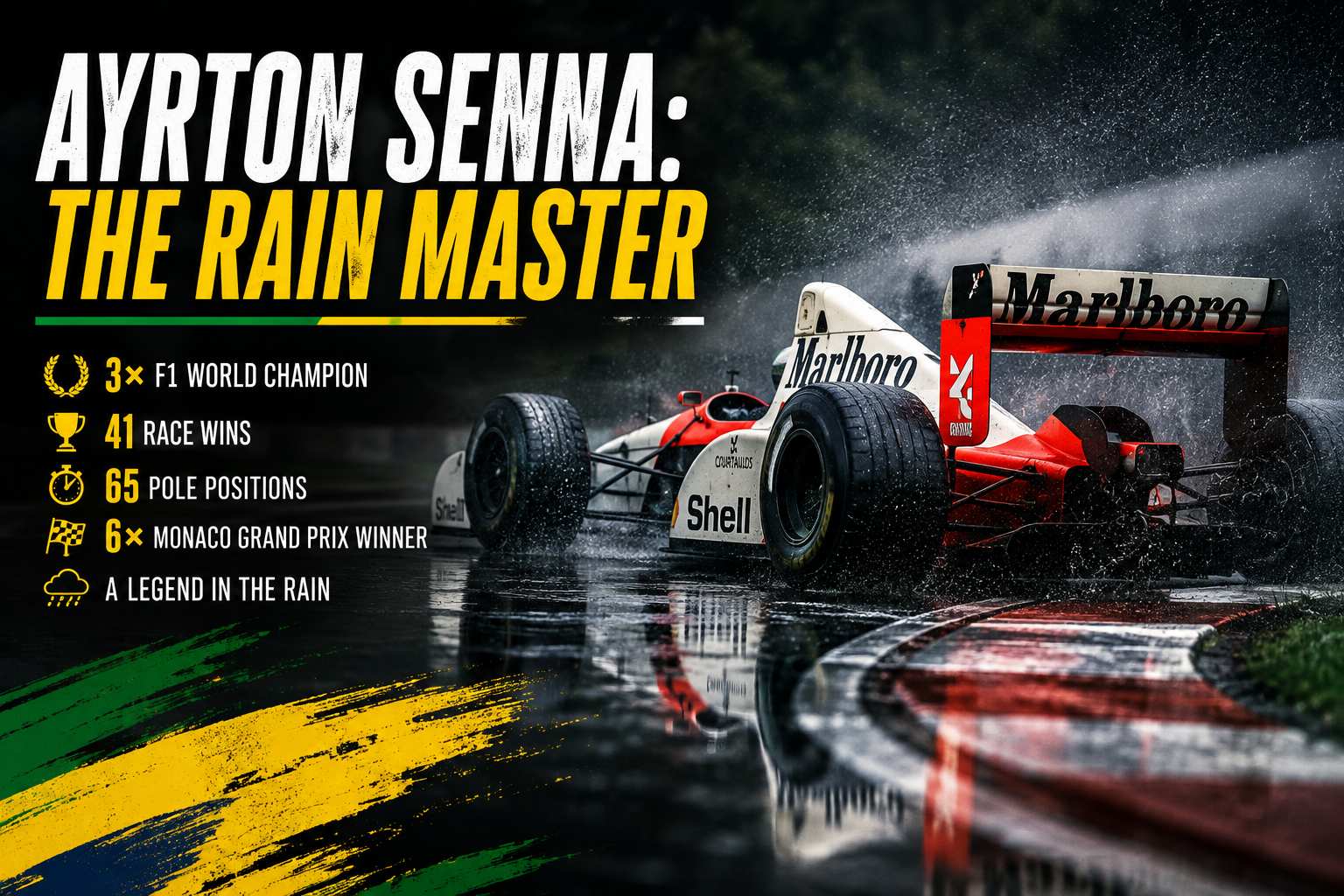
There are great Formula 1 drivers, there are world champions, and then there are drivers whose names become bigger than the sport itself. Ayrton Senna belongs in that final category.
More than three decades after his final race, Senna remains one of the most recognizable and beloved figures Formula 1 has ever produced. To millions of fans, particularly those in his home country of Brazil, he was more than someone who drove a race car incredibly fast. He represented passion, determination, faith, and an almost obsessive desire to be the best.
His career produced three Formula 1 World Championships, 41 victories, 65 pole positions, unforgettable drives in the rain, one of the greatest rivalries in sports history, and a record six victories around the streets of Monaco. But numbers alone cannot explain Ayrton Senna. To understand why his name still carries so much weight today, you have to understand the man behind the helmet.
A Brazilian Icon
Senna made his Formula 1 debut in 1984, but it did not take long for the world to realize that Brazil had produced someone special. His incredible performance at a rain-soaked Monaco that same year offered an early glimpse of what was coming. Senna had an extraordinary ability to find grip and speed in conditions where other drivers struggled simply to keep their cars on the circuit.
As his career grew, so did his importance back home. Brazil was going through a difficult period economically and socially, and Senna became a source of national pride. Sunday mornings became an event. Millions watched one of their own compete against the best drivers in the world, and when Senna won, the Brazilian flag followed him.
He did not simply represent Brazil. For many Brazilians, Ayrton Senna became Brazil.
Senna vs. Prost
You cannot tell Senna’s story without Alain Prost. When Senna joined McLaren in 1988, he was paired with an established champion in Prost, and what followed became one of the fiercest rivalries Formula 1 has ever seen. They were teammates, championship rivals, and eventually bitter adversaries.
Senna captured his first World Championship in 1988. Prost answered by winning the championship in 1989 after their infamous collision at Suzuka. One year later, Senna and Prost collided at Suzuka again, this time securing the championship for Senna. It was controversial, it was personal, and it helped define an era of Formula 1.
Yet time eventually softened the relationship between the two legends. By the end of Senna’s life, much of the bitterness had faded, and Prost would later become one of the trustees of the Ayrton Senna Institute. That feels fitting. Two men whose careers became forever connected eventually had their legacies connected as well.
The Master of Monaco
If there was one circuit that belonged to Ayrton Senna, it was Monaco. Senna won the Monaco Grand Prix six times, including five consecutive victories from 1989 through 1993.
Monaco demands precision unlike almost anywhere else. The barriers are inches away, overtaking is incredibly difficult, and one small mistake can end your afternoon instantly. Senna seemed built for it.
His qualifying lap there in 1988 has become part of Formula 1 folklore. Senna later described reaching a state where he felt almost beyond conscious control of the car, operating on instinct as he continued going faster. It perfectly captured what made him different. For Senna, driving was not simply mechanical. At his best, it seemed almost spiritual.
The Rain Master
There is a reason Ayrton Senna became known as the Rain Master.
Wet conditions can expose even the greatest drivers. Grip disappears, visibility becomes terrible, and the smallest mistake can send a car off the circuit. For Senna, those conditions often seemed to do the opposite. When the rain arrived, the gap between him and everyone else could become even more obvious.
The first great example came at Monaco in 1984. Driving for Toleman in only his sixth Formula 1 start, Senna charged through the field in heavy rain and began rapidly closing on race leader Alain Prost. The race was stopped early because of the conditions, leaving Senna second, but the performance announced his talent to the Formula 1 world.
Then there was Donington Park in 1993. Starting fourth in a wet European Grand Prix, Senna fell to fifth before producing one of the most famous opening laps in Formula 1 history. By the end of the first lap, he had passed Michael Schumacher, Karl Wendlinger, Damon Hill, and Alain Prost to take the lead. He eventually won the race by more than a minute over Prost.
Those performances became part of the Senna legend. He did not have more grip than everyone else. He simply seemed to understand where to find it before they did.
When the skies opened and conditions became unpredictable, Ayrton Senna was often at his most dangerous.
That is why, decades later, the nickname still fits.
The Rain Master.
More Than Racing
Away from Formula 1, Senna quietly donated millions to charitable causes in Brazil, particularly those focused on helping disadvantaged children. After his death, that mission became the Instituto Ayrton Senna, established by his family in 1994.
The organization has continued working to improve educational opportunities for children and young people across Brazil, meaning Senna’s impact has lasted far beyond anything he accomplished inside a Formula 1 car.
There is something powerful about that legacy. Championship trophies eventually collect dust and records eventually get broken. Helping change someone’s life lasts much longer.
A Legacy That Never Left
The easiest way to understand Ayrton Senna’s legacy is simply to look around Formula 1 today. Drivers who were not even alive when Senna raced still speak about him. Helmets continue to carry tributes to his famous yellow design, and fans who never watched him compete live know his name.
Every generation eventually discovers the footage: the rain, the qualifying laps, Monaco, Suzuka, and the yellow helmet sitting inside a McLaren. Then they understand why people still talk about him.
Ayrton Senna won three World Championships and established himself as one of the greatest drivers Formula 1 has ever seen, but his story became much bigger than racing. He became a symbol of Brazil, helped people who would never sit inside a Formula 1 paddock, inspired generations of drivers, and left an impact on the sport that can still be felt more than three decades later.
Some champions are remembered for their statistics. Legends are remembered for how they made people feel.
Ayrton Senna was a legend.
If you enjoyed this edition of Stories of Legends, make sure to like and subscribe to Ethical Sports Takes for more stories from the athletes who left a lasting impact on sports and the world beyond it.
Leave a Reply