The backwards hat. The smile. The home-run robberies at the wall. And, of course, that swing.
Maybe the most beautiful swing baseball has ever seen.
Griffey made baseball look effortless. He could hit for power, cover center field, make spectacular catches and then walk back into the dugout looking like he was simply having fun playing the same game he had loved since he was a kid.
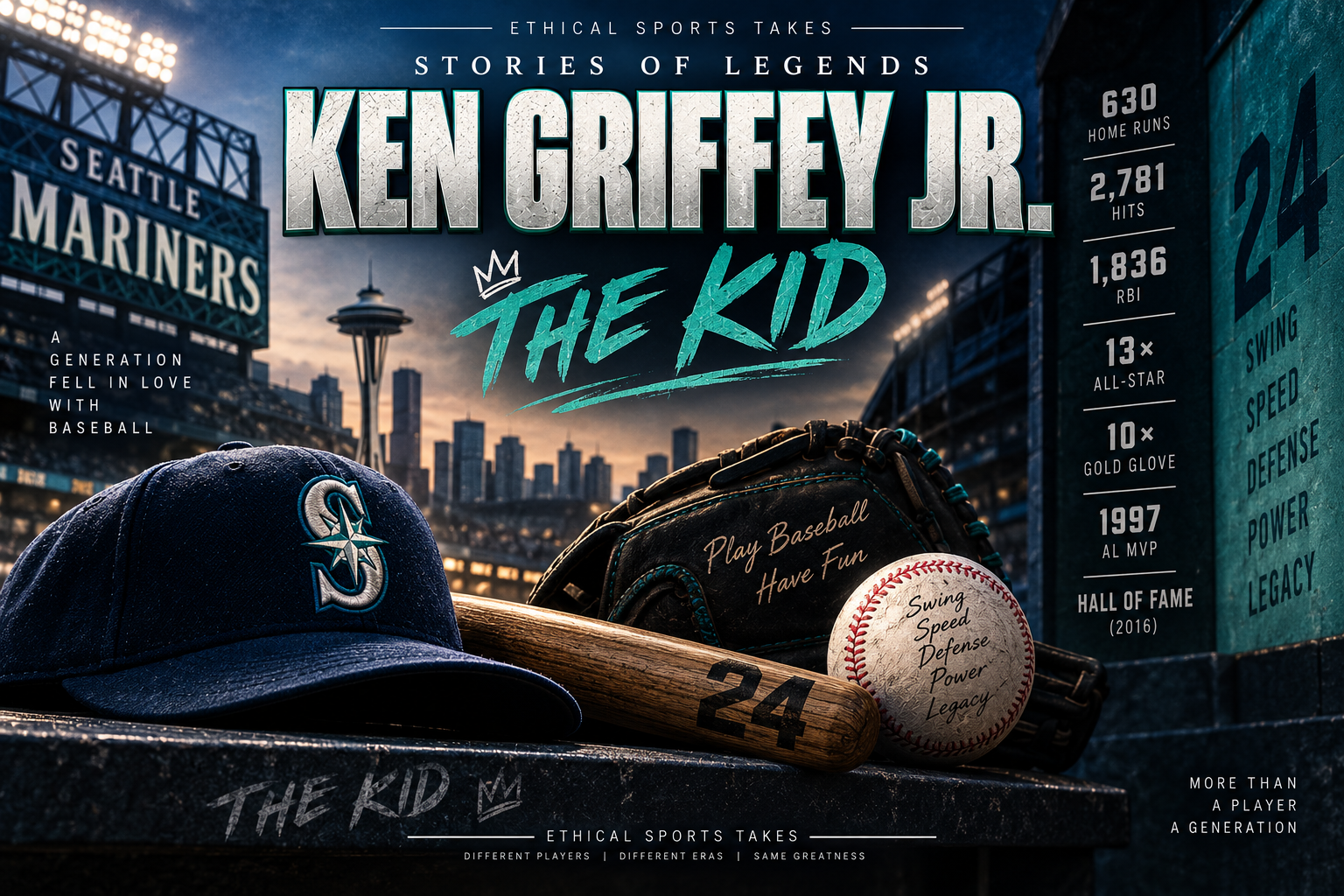
By the time his career was finished, Griffey had hit 630 home runs, made 13 All-Star teams, won 10 Gold Gloves and established himself as one of the defining athletes of his generation.
This is the story of The Kid.
Baseball Was in His Blood
Griffey didn’t grow up far away from Major League Baseball.
His father, Ken Griffey Sr., spent 19 seasons in the majors and was part of Cincinnati’s famous Big Red Machine. Junior grew up around professional baseball, watching his father play the game at its highest level.
But being the son of a major leaguer didn’t guarantee anything. Griffey had to become great himself.
The Seattle Mariners selected him with the first overall pick in the 1987 MLB Draft, and by 1989, at only 19 years old, he was already in the majors.
It didn’t take very long to realize Seattle had something special. By his second season, Griffey was an All-Star and a Gold Glove winner.
And then baseball gave us something that sounds like it belongs in a movie.
Father and Son
In 1990, Ken Griffey Sr. joined the Mariners.
For the first time in Major League Baseball history, a father and son played together as teammates.
That alone would have been special enough.
Then came September 14, 1990.
Griffey Sr. stepped to the plate and hit a home run. Junior came up immediately after him.
Home run.
Father and son had hit back-to-back home runs in a Major League Baseball game.
There are records involving bigger numbers and moments with greater championship implications, but there might not be many cooler baseball moments than that.
For Griffey Jr., though, the best was still ahead.
The Face of Seattle
During the 1990s, Griffey became the face of the Mariners and eventually one of the faces of baseball itself.
He had everything.
Power at the plate. Speed. Defense. Athleticism. Personality.
And that swing.
There was almost no wasted movement. Griffey’s left-handed swing looked smooth whether the ball landed in an outfielder’s glove or 400 feet away in the seats.
But Griffey wasn’t simply an offensive superstar. He became one of baseball’s premier defensive center fielders, winning 10 consecutive Gold Glove Awards from 1990 through 1999.
He could beat you at the plate and then take a home run away from you in the field.
That combination made him special.
The Slide That Seattle Will Never Forget
One of the defining moments of Griffey’s career came during the 1995 postseason.
Seattle faced the New York Yankees in the American League Division Series and fell behind 2-0 in the best-of-five series. The Mariners fought back to force a decisive Game 5.
The game eventually reached the 11th inning with Seattle trailing 5-4. Joey Cora reached base. Griffey followed with a single.
Then Edgar Martinez ripped a double down the left-field line.
Cora scored.
Griffey flew around the bases from first.
Safe.
Seattle won the game 6-5 and completed the comeback against New York.
Griffey had also crushed five home runs in the five-game series, but it was the image of him racing home and scoring the winning run that became one of the most iconic moments in Mariners history.
The significance went beyond one playoff series. The Mariners’ success helped build momentum for keeping Major League Baseball in Seattle and eventually contributed to the construction of a new ballpark.
Griffey wasn’t just becoming a Seattle legend.
He was helping change the future of baseball in the city.
The MVP
By 1997, Griffey was at the absolute height of his powers.
And the numbers were ridiculous.
56 home runs.
147 RBI.
125 runs.
.304 batting average.
Griffey led the American League in home runs, RBI and runs scored and was unanimously named the 1997 American League MVP.
He followed that season by hitting another 56 home runs in 1998.
During an eight-season stretch from 1993 through 2000, Griffey recorded seven seasons with at least 40 home runs. The only interruption came in 1995, when a broken wrist limited him to 72 games.
At his peak, Griffey wasn’t merely one of baseball’s best players.
He was one of the biggest stars in American sports.
Going Home to Cincinnati
After the 1999 season, Griffey was traded from Seattle to the Cincinnati Reds.
There was something fitting about it.
Griffey had grown up around Cincinnati while his father starred for the Reds, and now Junior had the opportunity to play for the same franchise.
His first season went exactly how everyone hoped. Griffey hit 40 home runs with 118 RBI in 2000.
It looked like another great chapter of his career had begun.
Then the injuries arrived.
Fighting Through Injuries
After arriving in Cincinnati, Griffey’s career became more difficult as injuries repeatedly interrupted his seasons. Hamstring, knee, ankle and shoulder problems cost him significant time, particularly during the early 2000s.
But Griffey kept going.
Even as staying healthy became more difficult, he continued climbing baseball’s all-time home run list and adding to a career that had already established him as one of the greatest players of his generation.
There is no reason to spend time wondering about numbers that never happened.
Griffey hit 630 home runs. That’s what happened. And 630 home runs is legendary.
600 Home Runs and a Return to Seattle
Griffey continued climbing baseball’s record books and eventually hit his 600th career home run in 2008, joining one of baseball’s most exclusive power-hitting clubs.
After a brief stint with the Chicago White Sox, Griffey returned to where everything had started.
Seattle.
He played his final two seasons with the Mariners before retiring in 2010.
The Kid had come home.
Cooperstown
There was never much doubt about where Griffey’s career would eventually lead.
In 2016, he became a first-ballot member of the Baseball Hall of Fame.
Griffey appeared on 437 of 440 ballots — 99.32% of the vote.
At the time, that was the highest voting percentage in Baseball Hall of Fame history. Three voters were all that kept him from becoming the first unanimous selection.
His final résumé tells the story:
630 career home runs
2,781 career hits
1,836 RBI
13-time All-Star
1997 American League MVP
10-time Gold Glove winner
7-time Silver Slugger winner
Baseball Hall of Fame
But numbers alone don’t completely explain Ken Griffey Jr.
The Kid
Baseball has produced players with more home runs. Players with more hits. Players with more championships.
But very few have ever made the game look as cool as Ken Griffey Jr.
The backwards hat became part of his identity. The swing became something young players tried to imitate. His defensive highlights made center field feel like his personal playground.
And through it all, he carried a nickname that somehow still fit even as he became one of the greatest players in baseball history.
The Kid.
Griffey doesn’t need hypothetical numbers to define his greatness. His career speaks for itself.
He was a superstar. He was an MVP. He was one of the greatest defensive center fielders of his generation. He hit 630 home runs and walked into Cooperstown with 99.32% of the vote.
And most importantly, Ken Griffey Jr. made an entire generation fall in love with baseball.
That is the legacy of The Kid.
Like the article? Subscribe to Ethical Sports Takes for more Stories of Legends and sports history.
Leave a Reply