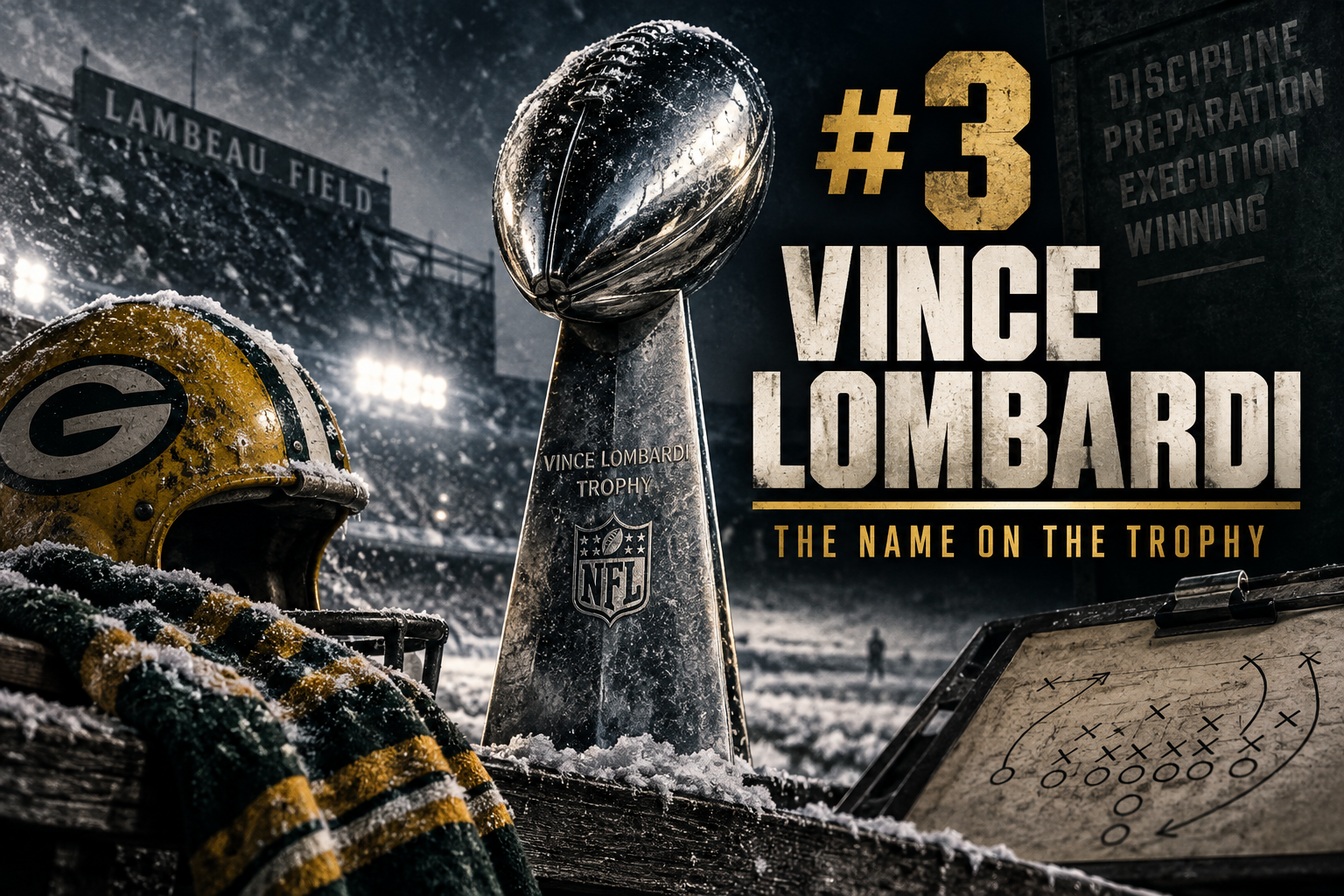
You must have been a pretty damn good coach if the trophy every NFL team spends an entire season chasing is named after you.
Vince Lombardi did not have the longest coaching career in NFL history. He did not spend 30 years piling up victories or coach through several different eras of football. His greatness came from just how much winning he managed to pack into such a short period of time. He arrived in Green Bay, took over one of the worst teams in football, built one of the greatest dynasties the NFL has ever seen, and became so synonymous with winning that the league’s ultimate prize now carries his name.
When Lombardi became head coach of the Green Bay Packers in 1959, this was not the powerhouse we remember today. Green Bay had finished 1–10–1 the previous season and had not posted a winning record since 1947. Lombardi changed that immediately. The Packers went 7–5 in his first season, earning Lombardi Coach of the Year honors. One year later, Green Bay was playing for the NFL Championship.
They lost that championship game to the Philadelphia Eagles. It would become the only postseason loss of Lombardi’s entire head-coaching career.
From there, the Packers became a machine. Green Bay won back-to-back NFL championships in 1961 and 1962. After a couple of years without a title, Lombardi somehow built another championship run and won three consecutive NFL championships from 1965 through 1967.
Think about that for a second. Five championships in seven seasons.
And that final championship produced one of the most famous games in NFL history.
The Ice Bowl
On December 31, 1967, the Packers faced the Dallas Cowboys at Lambeau Field in the NFL Championship Game. The temperature was around 13 degrees below zero at kickoff, with a wind chill far below that. The field became frozen, players struggled with the brutal conditions, and the game became known forever as the Ice Bowl.
Green Bay found itself trailing 17–14 late in the fourth quarter. Lombardi’s Packers then put together one final drive, moving down the frozen field until they reached the Dallas 1-yard line with seconds remaining. Green Bay could have kicked a field goal and forced overtime. Instead, Lombardi went for the championship.
Quarterback Bart Starr came to the sideline and discussed the final play with Lombardi. Starr believed he could sneak the ball behind center Ken Bowman and guard Jerry Kramer. Lombardi gave him the green light. Starr took the snap, followed his blockers and crossed the goal line.
Touchdown. Green Bay won 21–17 and captured its third consecutive NFL championship. No NFL team has won three straight league championships since.
Winning the First Super Bowl
Lombardi was also given the responsibility of representing the established NFL against the upstart AFL in the first AFL–NFL World Championship Game, which would later become known as Super Bowl I. There was enormous pressure on Green Bay. Losing would have been more than one championship defeat; it would have been an embarrassment for the NFL.
The Packers handled the Kansas City Chiefs 35–10. One year later, Green Bay returned and defeated the Oakland Raiders 33–14 in Super Bowl II. Lombardi walked away from the Packers after that game having won five championships, including the first two Super Bowls.
That is one hell of an exit.
Everyone Knew What Was Coming
One of the coolest things about Lombardi’s teams was that their identity was not built around fooling opponents. It was built around executing better than them.
The Packers Sweep became one of the most famous plays in football history. Green Bay’s guards would pull outside, create a running lane and allow backs such as Paul Hornung and Jim Taylor to attack the edge. Teams studied it, prepared for it and knew it was coming.
Lombardi kept running it anyway.
That almost perfectly represented his philosophy. Football did not always have to be complicated. If every player knew his responsibility and executed it better than the man across from him, knowing what was coming did not necessarily help you stop it.
Lombardi’s Packers were disciplined, physical and prepared. He demanded excellence, and his teams consistently delivered it. The roster was loaded with players who would become football legends: Bart Starr, Jim Taylor, Paul Hornung, Ray Nitschke, Forrest Gregg, Willie Davis, Willie Wood and Herb Adderley among them. Having great players and turning them into a dynasty are two different things. Lombardi did the latter.
He Did It Again in Washington
After stepping away from coaching following Super Bowl II, Lombardi eventually returned to the sideline with Washington in 1969. The franchise had endured 14 consecutive seasons without a winning record. In Lombardi’s first year, Washington went 7–5–2.
One season. Immediate winning record.
Unfortunately, we never got to see what Lombardi could have built there. He was diagnosed with colon cancer and died in September 1970 at only 57 years old.
His coaching career was incredibly short compared with many of the other names on this list, but what he accomplished during it was ridiculous. Across his ten seasons as an NFL head coach, Lombardi never had a losing season. His postseason record was 9–1. He won five NFL championships in seven years, the first two Super Bowls, and coached the last team to win three consecutive NFL championships.
Shortly after his death, the trophy awarded to the Super Bowl champion was renamed the Vince Lombardi Trophy.
More than half a century later, every NFL season still ends with his name. Players dream about lifting the Lombardi Trophy, coaches dedicate their careers to winning one, and franchises can spend decades desperately trying to bring one home.
There have been coaches with longer careers. There have been coaches with more total victories. But very few coaches have ever represented winning itself quite like Vince Lombardi.
Five championships. The Ice Bowl. The first two Super Bowls. A 9–1 playoff record. One of the greatest dynasties professional football has ever seen.
And, of course, the damn trophy has his name on it.
Vince Lombardi is #3 on my list of the greatest NFL head coaches of all time.
If you enjoyed this article, leave a like and subscribe to Ethical Sports Takes for more rankings, stories, and sports opinions.
Leave a Reply