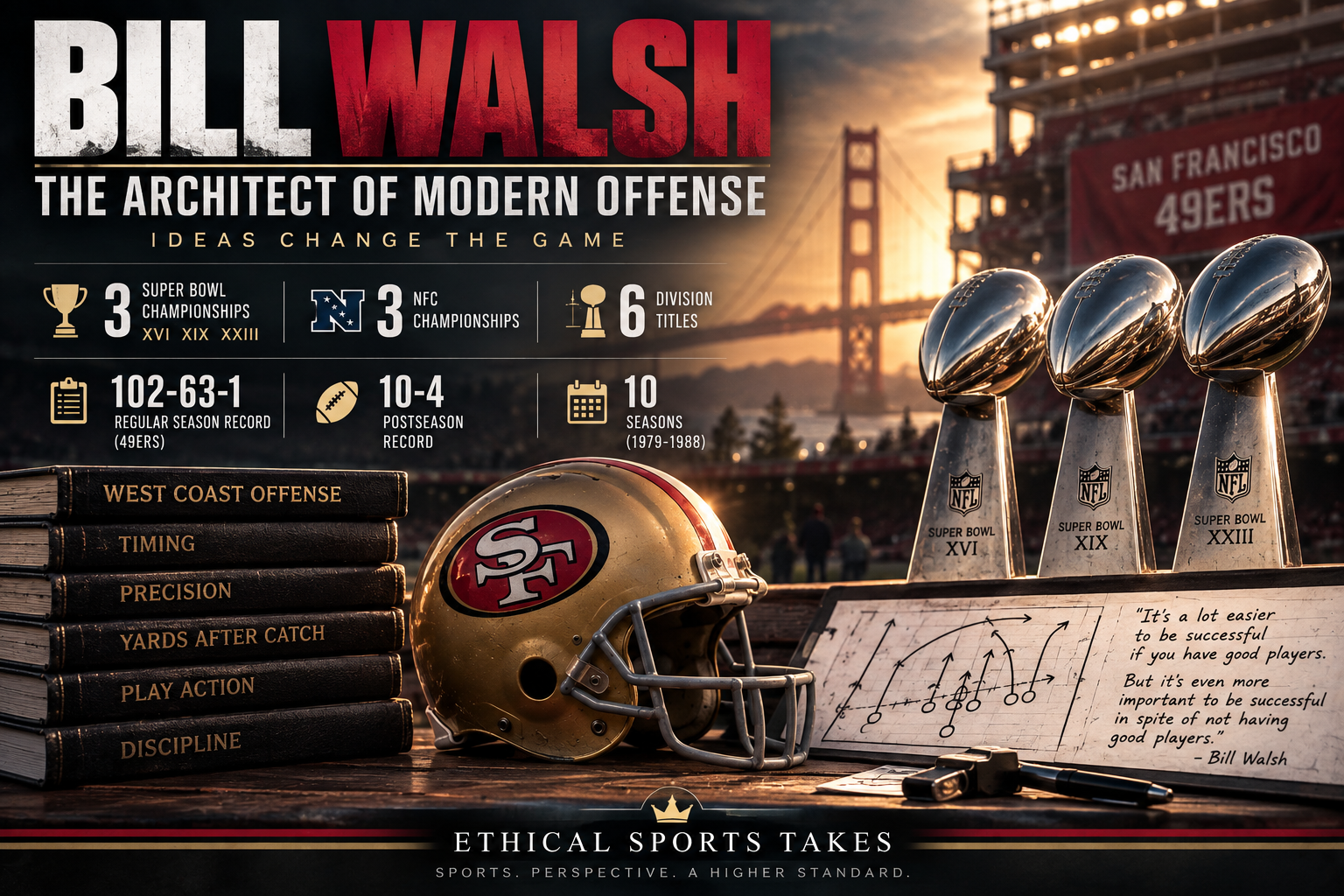
Bill Walsh won three Super Bowls with the San Francisco 49ers and helped build one of the greatest dynasties the NFL has ever seen. But that alone is not why I have him ranked as the second-greatest head coach in NFL history. For me, Walsh’s greatness comes down to something even bigger: he didn’t just dominate his era, he helped change the way football would be played after him.
Walsh didn’t immediately walk into the NFL as a head coach. He spent years developing his offensive philosophy before San Francisco ever gave him his opportunity. After coaching at the high-school and college levels, Walsh entered the NFL with the Oakland Raiders in 1966 before joining Paul Brown’s Cincinnati Bengals staff in 1968. It was during his years in Cincinnati that the foundation of what would eventually become known as the West Coast offense began to take shape.
Walsh believed an offense could control a game through the passing attack. Timing, accuracy, quick decisions and short and intermediate throws could systematically move the football downfield. His offensive success wasn’t tied to one quarterback, either. Before Joe Montana, Walsh worked with quarterbacks including Ken Anderson and Dan Fouts, both of whom developed into outstanding NFL quarterbacks. The system and the coach existed before the superstar quarterback ever arrived in San Francisco.
Then, in 1979, Walsh finally got his opportunity.
Turning the 49ers Into Champions
Walsh inherited a disaster. The 49ers had finished 2–14 the season before he arrived, but only three years later, they were Super Bowl champions.
Walsh drafted Joe Montana in the third round in 1979, and Montana eventually became the perfect quarterback to execute his offense. Accuracy, anticipation, intelligence and timing combined perfectly with Walsh’s system. The moment that truly announced the arrival of Walsh’s 49ers came during the 1981 NFC Championship Game against the Dallas Cowboys. Trailing late in the fourth quarter, Montana rolled to his right and found Dwight Clark in the back of the end zone.
The Catch.
One of the most famous plays in NFL history sent San Francisco to its first Super Bowl. The 49ers then defeated the Cincinnati Bengals 26–21 in Super Bowl XVI, completing an unbelievable transformation from one of football’s worst teams into NFL champions.
Three seasons later, Walsh produced arguably his greatest team. The 1984 49ers went 15–1, becoming the first team in NFL history to win 15 regular-season games. San Francisco reached Super Bowl XIX, where Dan Marino and the Miami Dolphins were waiting. Marino had thrown for more than 5,000 yards and 48 touchdowns that season, but it didn’t matter. Montana threw for 331 yards and three touchdowns, added another 59 yards and a touchdown on the ground, and San Francisco crushed Miami 38–16.
Walsh now had two championships, and one final masterpiece was still to come.
The 1988 49ers finished the regular season 10–6, but once the playoffs began, Walsh’s team found another level. San Francisco defeated Minnesota 34–9 before going into Chicago and destroying the Bears 28–3 in the NFC Championship Game. That sent the 49ers back to the Super Bowl for another meeting with Cincinnati.
With 3:10 remaining in Super Bowl XXIII, San Francisco took possession at its own eight-yard line trailing 16–13. Ninety-two yards separated Walsh from his third championship. Montana calmly moved the offense down the field before finding John Taylor for the game-winning touchdown with only 34 seconds remaining.
49ers 20. Bengals 16. Bill Walsh was a three-time Super Bowl champion.
Then he walked away.
Walsh retired as the 49ers’ head coach after the 1988 season at only 57 years old. He finished his San Francisco coaching career with six division championships, three NFC championships, three Super Bowl championships and a 10–4 postseason record.
For almost any other coach, that résumé would be the entire story. For Bill Walsh, it is only part of his legacy.
His Influence Outlived His Career
One of the greatest demonstrations of what Walsh built actually came after he retired. His defensive coordinator, George Seifert, took over as head coach and San Francisco won the Super Bowl the very next season. Seifert eventually won another championship with Steve Young following the 1994 season.
Walsh had walked away, yet the machine he helped construct kept winning. He didn’t simply coach a great team for a few seasons. He helped build an organization capable of surviving without him.
His influence also spread far beyond San Francisco. George Seifert, Mike Holmgren, Dennis Green and others worked under Walsh before becoming NFL head coaches themselves. Those coaches then developed coaches of their own, creating an enormous football lineage that eventually included names such as Mike Shanahan, Andy Reid, Jon Gruden, Tony Dungy, Pete Carroll and Gary Kubiak.
Walsh retired from NFL head coaching after the 1988 season, yet generations later, coaches connected to his tree were still winning championships and shaping NFL football.
His ideas didn’t retire when he did. They multiplied.
The West Coast Offense
And this is ultimately why Bill Walsh sits at No. 2 on my list.
The championships prove he could coach. The dynasty proves he could build. But the West Coast offense proves he changed football.
Walsh built his passing game around timing, precision, quarterback footwork, quick decisions, short and intermediate routes and creating yards after the catch. The passing game didn’t simply have to be about throwing the football deep. It could control the game, with short passes essentially becoming an extension of the running game.
Football has obviously evolved tremendously since Walsh coached. Modern NFL teams aren’t simply opening his old playbook and running it exactly as he did, but many of the principles he helped establish became part of the DNA of offensive football.
There have been coaches who won more games than Bill Walsh. There have been coaches who coached longer and coaches who won more championships. But very few can say they built a dynasty, won three Super Bowls, watched the organization continue winning after they retired, developed coaches whose influence spread across generations, and helped create an offensive philosophy whose fingerprints remain on the sport decades later.
That is Bill Walsh’s legacy.
The three Super Bowls made him one of the greatest coaches of his generation. His influence on everything that came afterward made him one of the greatest coaches of all time.
Bill Walsh didn’t simply master football as it existed. He helped create the football that came next.
That is why Bill Walsh is my #2 greatest NFL head coach of all time.
Like the article and subscribe to Ethical Sports Takes for more rankings, stories and sports opinions.
Leave a Reply