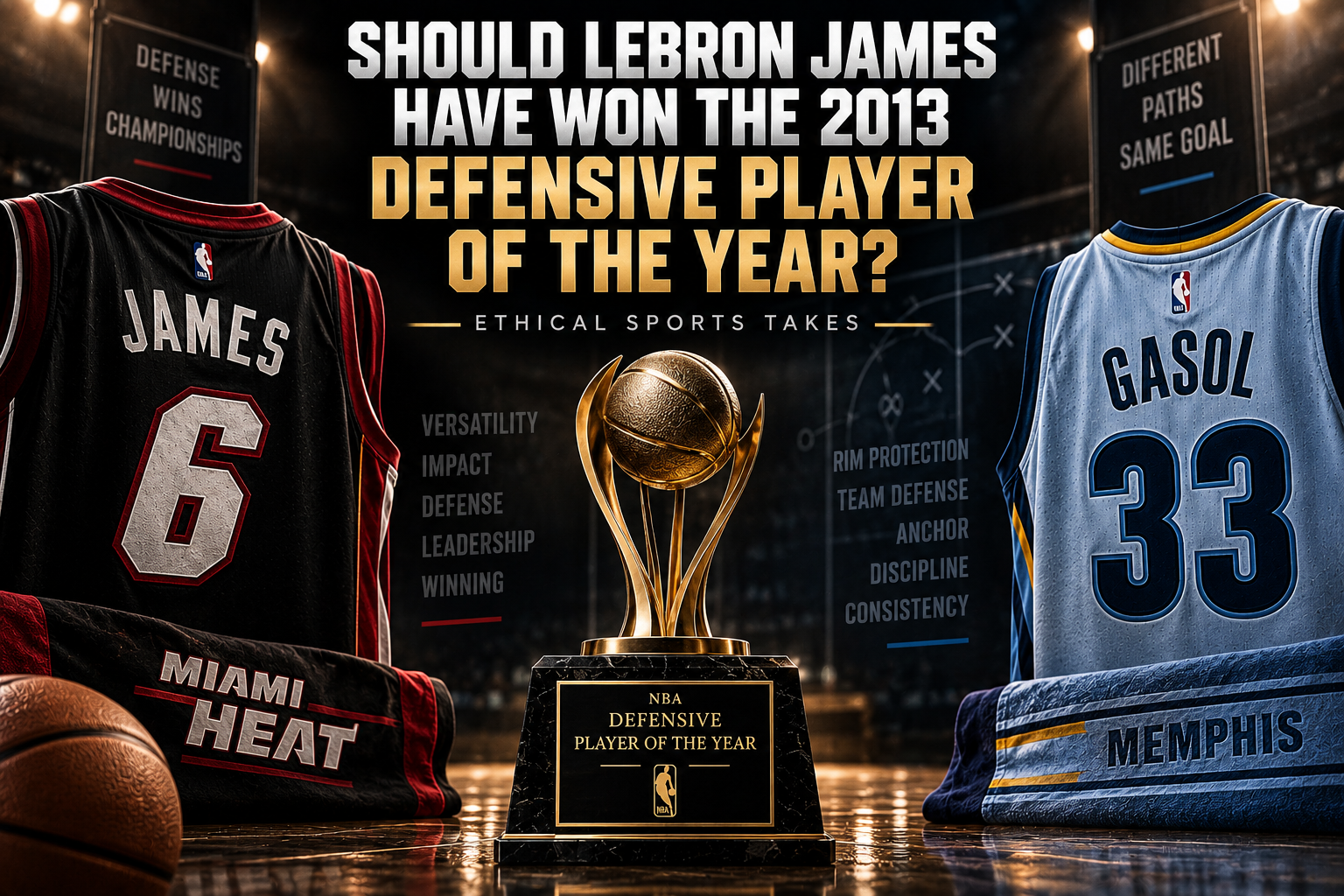
It is no secret that it still stings LeBron James that there is one major individual award missing from his résumé: Defensive Player of the Year. LeBron has openly talked about believing he should have won the award in 2013, and when you look back at that season, it is not difficult to understand why.
The 2012–13 season may have been the absolute peak of LeBron as an all-around basketball player. He was 28 years old, at the height of his athletic powers, already one of the smartest players in basketball and leading a Miami Heat team that would eventually win 66 games and an NBA championship. Offensively, he was nearly unstoppable. Defensively, he had become something equally frightening: a player who could legitimately guard almost anyone on the floor.
Marc Gasol ultimately won Defensive Player of the Year, and this is not an argument that Gasol was undeserving. He was a tremendous defender and the anchor of one of basketball’s best defensive teams. But more than a decade later, the question remains: Should LeBron James have actually won the 2013 Defensive Player of the Year award?
LeBron at His Defensive Peak
One of the problems with evaluating LeBron’s 2013 defense purely through statistics is that numbers cannot fully capture what made him special. He averaged 1.7 steals and 0.9 blocks per game, recorded 4.7 Defensive Win Shares and finished with a 2.4 Defensive Box Plus/Minus. Those are excellent numbers, particularly for someone simultaneously carrying one of the largest offensive responsibilities in basketball.
But LeBron’s greatest defensive weapon was versatility. Miami could ask him to defend a point guard bringing the ball up the floor and then have him battle a power forward later in the game. He had the speed to stay with guards, the strength to handle bigger forwards and the athleticism to recover when he appeared beaten. In certain situations, Miami could even switch him onto centers.
This was the version of LeBron who seemed almost perfectly designed for positionless basketball before positionless basketball completely took over the NBA. At roughly 6-foot-9 and 250 pounds, he possessed the physical strength of a big man while maintaining the speed and lateral movement of someone considerably smaller.
Then there was his ability to erase mistakes. A player could seemingly have an open transition opportunity only for LeBron to appear from behind and turn what looked like an easy layup into a blocked shot. His chase-down blocks eventually became one of the defining defensive plays of his career, but his impact went much further than highlight-reel rejections. He could switch, help, recover, disrupt passing lanes and defend multiple positions without Miami having to completely change its defense around him.
The Statistics Don’t Tell the Whole Story
Defensive statistics have always been more difficult to evaluate than offensive numbers. Points, assists and shooting percentages tell us quite a bit about what happened offensively. A great defensive possession can end with absolutely nothing appearing in the box score.
Maybe LeBron forced the opposing team’s best scorer to give up the ball. Maybe his help defense prevented someone from attacking the rim. Maybe a switch that would normally create a mismatch suddenly wasn’t a mismatch because LeBron could defend the player anyway. None of those necessarily produce a steal or block.
That is why watching 2013 LeBron matters when having this discussion. This wasn’t an aging superstar occasionally turning up the defensive intensity for an important possession. LeBron was still capable of impacting games defensively throughout the season while also averaging 26.8 points, 8.0 rebounds and 7.3 assists per game on the other end. He was eventually rewarded with his fourth NBA MVP award, receiving 120 of 121 first-place votes.
He also earned First Team All-Defense, his fifth consecutive selection to the First Team. This was not reputation carrying him years beyond his defensive prime. LeBron was right in the middle of it.
But there was another trophy he nearly took home.
Marc Gasol’s Case
Before arguing that LeBron should have won, Marc Gasol deserves his credit. Gasol was the defensive anchor of the Memphis Grizzlies, and Memphis was an absolute nightmare to play against. The Grizzlies allowed an NBA-low 88.7 points per game, and Gasol’s intelligence, positioning, rim protection and communication were enormous reasons why their defense worked.
Gasol averaged 1.7 blocks and 1.0 steal per game and helped Memphis win 56 games. He ultimately received 30 first-place votes and 212 total points in Defensive Player of the Year voting. LeBron finished second with 18 first-place votes and 149 total points.
So this was not some outrageous winner who had no argument for the award. Gasol had a very good one. If you believed the best defensive player should be the anchor in the middle of the NBA’s stingiest scoring defense, Gasol made perfect sense.
But then something happened that made the result much more interesting.
The Defensive Player of the Year Was Second Team All-Defense
After Marc Gasol was named the best defensive player in basketball, the NBA announced its All-Defensive teams.
LeBron James made First Team All-Defense. Marc Gasol made Second Team All-Defense.
Yes, you read that correctly.
The player who won Defensive Player of the Year was not selected to First Team All-Defense, while the player who finished second for Defensive Player of the Year was.
There is an important explanation for this apparent contradiction. At the time, the awards were decided by different voting groups. Defensive Player of the Year was selected by sportswriters and broadcasters, while NBA head coaches selected the All-Defensive teams. Coaches were also not permitted to vote for players on their own teams.
So this wasn’t literally one group of voters declaring Gasol the best defender in basketball and then immediately putting him on the Second Team. But it does show that there was disagreement over who deserved to be considered the league’s best defender.
And just how unusual was Gasol’s Second Team selection?
Since Defensive Player of the Year was introduced in 1982–83, only four DPOY winners have failed to make First Team All-Defense during the same season: Alvin Robertson in 1986, Dikembe Mutombo in 1995, Tyson Chandler in 2012 and Marc Gasol in 2013.
Gasol was actually the second consecutive DPOY winner to end up on the Second Team after Chandler had done it the previous season.
But Gasol’s situation is particularly interesting when discussing LeBron because the man who finished directly behind him for Defensive Player of the Year was on the First Team. Gasol received only five First-Team votes from NBA head coaches, while LeBron received 25 and comfortably earned his First Team selection.
The media chose Gasol as Defensive Player of the Year. The coaches who had to prepare their teams to play against these guys put LeBron on the First Team and Gasol on the Second Team.
That does not automatically prove the media got the DPOY vote wrong. Different positions were involved, different groups voted for the awards and Gasol’s defensive impact went far beyond his individual numbers. But it does tell us something important: there was clearly not universal agreement that Marc Gasol was the best defensive player in basketball that season.
When we’re asking whether LeBron deserved the award instead, that is a significant piece of evidence in his favor.
The Case for LeBron
My argument for LeBron ultimately comes down to one word: versatility.
Gasol was an outstanding defensive center, but LeBron could affect an offense in almost every conceivable way. Miami could deploy him against the opposing team’s primary ball-handler, best wing scorer or a bigger forward. He could switch screens, defend in isolation, play passing lanes, provide help defense and turn defense into transition offense almost instantly.
There simply weren’t many weaknesses for an opposing offense to target. LeBron could change his defensive assignment depending on what Miami needed that night, and his combination of size, speed and basketball IQ gave Erik Spoelstra options that very few defenders in NBA history could provide.
There is also something extraordinary about the workload. LeBron was Miami’s offensive engine while simultaneously being trusted with some of its most difficult defensive responsibilities. He didn’t have the luxury of conserving all his energy for one end of the court. He was expected to do everything, and for most of that season, he basically did.
What Winning DPOY Would Have Meant
This is also why losing the award probably still bothers LeBron. Look at what his 2012–13 season ultimately became.
He won NBA MVP, the NBA championship and Finals MVP. He made First Team All-NBA and First Team All-Defense.
Add Defensive Player of the Year to that list and we’re talking about an even more ridiculous individual season. Winning MVP and DPOY in the same year is already extraordinarily rare. Combine those with a championship and Finals MVP, and LeBron’s 2013 campaign would have stood as one of the most decorated seasons basketball has ever seen.
It also would have filled one of the very few empty spaces on his career résumé.
So, Should LeBron Have Won?
Marc Gasol deserved to be in the conversation. He anchored the NBA’s stingiest scoring defense and was one of the smartest, most impactful defensive big men of his generation. Calling Gasol undeserving would be rewriting history simply to strengthen LeBron’s case.
But if I could cast a vote again?
I’m voting for LeBron James.
At his defensive peak, LeBron offered something extraordinarily rare. He combined elite athleticism, strength, anticipation, help defense and the ability to legitimately defend across positions. He could impact virtually every type of offensive player an opponent put on the floor while simultaneously carrying an MVP-level offensive workload.
And perhaps the strangest evidence remains the simplest: LeBron James finished second for Defensive Player of the Year and made First Team All-Defense. Marc Gasol won Defensive Player of the Year and made Second Team All-Defense.
Different voters explain how it happened. They don’t make the debate any less fascinating.
Gasol was a worthy winner.
I just believe LeBron James was the better defensive player in 2013—and should have the Defensive Player of the Year trophy to show for it.
What do you think? Should LeBron James have won the 2013 Defensive Player of the Year award, or did the voters get it right with Marc Gasol? Let us know your thoughts in the comments.
If you enjoyed this article, leave a like and subscribe to Ethical Sports Takes for more NBA debates, rankings, stories and weekly sports content.
Thanks for reading! 👑🏀
Leave a Reply