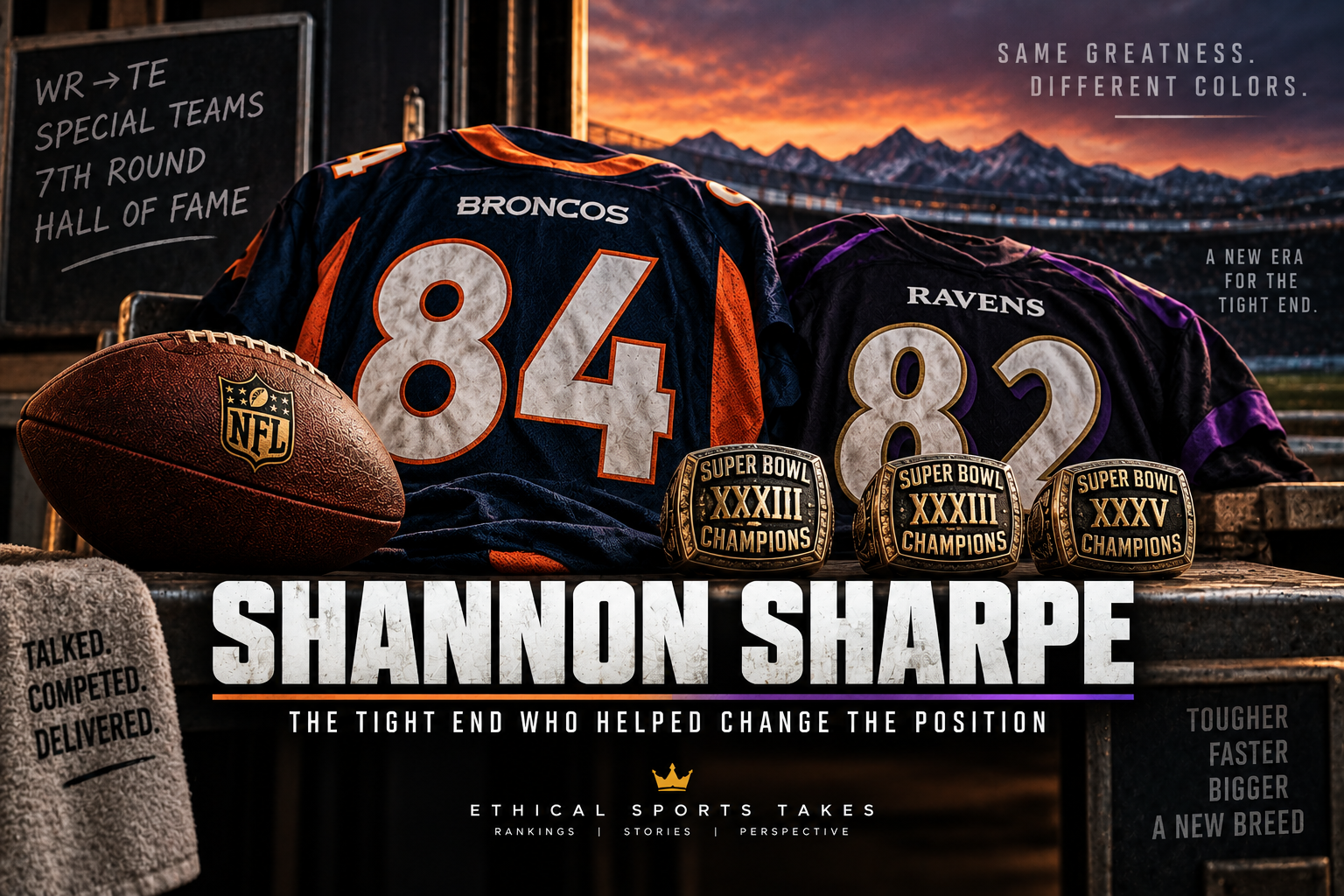
A Wide Receiver Without a Position
Shannon Sharpe did not enter the NFL looking like a future Hall of Fame tight end. He wasn’t even a tight end. Sharpe starred at Savannah State as a wide receiver, putting up huge numbers at the Division II level. But when the 1990 NFL Draft arrived, teams weren’t exactly fighting to get him. At roughly 6-foot-2 and 230 pounds, Sharpe was caught between positions. He was considered too big for the traditional wide receiver role and too small to fit the NFL’s idea of what a tight end was supposed to look like.
Denver finally selected him in the seventh round with the 192nd overall pick. There were no expectations of superstardom, and there wasn’t even certainty about where he belonged. Early in his career, Sharpe had to contribute on special teams while the Broncos searched for a way to take advantage of his unusual skill set.
Eventually, Denver stopped trying to figure out which traditional box Sharpe fit into. They created a different one.
Denver Had a Different Idea
The Broncos converted Sharpe from wide receiver to tight end, and suddenly everything that had made him difficult to evaluate became what made him difficult to defend. Sharpe wasn’t built like the massive traditional tight ends NFL defenses were accustomed to seeing, but he could run. He had spent years developing as a receiver. He understood routes, separation, catching the football in space and creating yards after the catch.
Instead of asking him to become another oversized blocker, Denver realized it could use him as a receiving weapon from the tight end position. Put a linebacker on Sharpe and he could run away from him. Put a defensive back on Sharpe and he had the size and physicality advantage. The player who supposedly didn’t have a position suddenly had one of the best positions imaginable.
Helping Reshape the Tight End Position
Sharpe did not invent the receiving tight end. Players such as Kellen Winslow and Ozzie Newsome had already demonstrated that tight ends could become major pieces of a passing offense. But Sharpe helped push that evolution another step forward.
For much of NFL history, the traditional tight end was viewed heavily through his ability to block. The position often functioned almost like an additional offensive lineman who could release into a route when needed. Sharpe flipped that expectation around. He could line up at tight end and become one of the primary receiving threats in the entire offense. His background as a wide receiver was not something Denver had to overcome. It became the reason he was special.
Modern football is filled with tight ends whose primary value comes from creating mismatches in the passing game. Move them around the formation, put them in the slot, attack linebackers and force defenses to choose between size and speed. Sharpe was helping demonstrate those possibilities decades ago.
From Project to All-Pro
Once Denver figured out how to use him, Sharpe’s career took off. In 1992, he caught 53 passes for 640 yards and earned the first Pro Bowl selection of his career. The following season, he exploded for 81 receptions, 995 yards and nine touchdowns.
Sharpe had officially become one of the premier tight ends in football. His peak would eventually produce four First-Team All-Pro selections, and he was selected to the Pro Bowl eight times. This wasn’t a player who merely benefited from John Elway throwing him the football. Sharpe became one of the defining offensive players of his generation.
And when Denver needed him most, he delivered.
13 Catches When Denver’s Season Was on the Line
One of Sharpe’s greatest individual performances came in the postseason following the 1996 season. Denver had gone 13-3 and entered the playoffs with legitimate Super Bowl expectations before being stunned by Jacksonville in the Divisional Round.
Sharpe did everything he possibly could to prevent it, catching 13 passes for 156 yards and a touchdown in one of the greatest postseason performances ever by a tight end. Denver’s season ended that afternoon, but Sharpe demonstrated something that would become an important part of his legacy: the bigger the game became, the more comfortable he seemed.
One year later, Denver would get another opportunity.
The Play That Helped Send Denver to the Super Bowl
The Broncos returned to the postseason after the 1997 season and fought their way to the AFC Championship Game against Pittsburgh. Late in the first half, Denver was backed up near its own goal line and facing third down. Pittsburgh had an opportunity to force the Broncos off the field and maintain control of the game.
Instead, John Elway found Sharpe for a crucial first down. The completion helped keep alive a 95-yard touchdown drive, giving Denver a lead it would never surrender. It wasn’t a touchdown catch or a play that dominates highlight reels decades later, but championships are often decided by plays exactly like that. When Denver desperately needed somebody to get open, Elway trusted Shannon Sharpe.
Back-to-Back Champions
The reward was a trip to Super Bowl XXXII against the defending champion Green Bay Packers. Denver entered as the underdog, while the AFC had lost 13 consecutive Super Bowls and the Broncos themselves carried the baggage of previous Super Bowl defeats.
None of it mattered. Denver defeated Green Bay 31-24, giving Sharpe his first championship and John Elway his long-awaited first Super Bowl victory. Then they did it again. The following season, Denver returned to the Super Bowl and defeated the Atlanta Falcons 34-19 in Super Bowl XXXIII.
Back-to-back championships. Sharpe was no longer simply an innovative receiving tight end with great statistics. He was a central piece of a championship era.
Elway Retired — Sharpe Kept Winning
After Elway retired, the Broncos’ championship window closed. Sharpe eventually left Denver and joined the Baltimore Ravens in 2000. It would have been easy for the move to represent the quiet final chapter of a great career.
Instead, Sharpe immediately helped another team win a championship.
Baltimore faced the Oakland Raiders in the 2000 AFC Championship Game, with the winner advancing to the Super Bowl. The Ravens were known for one of the greatest defenses in NFL history, but it was their veteran tight end who delivered the game’s biggest offensive blow.
Sharpe caught a short pass over the middle and took off. Ninety-six yards later, he was in the end zone. It remains one of the longest receiving touchdowns in NFL postseason history.
Think about the player making that play. This wasn’t a wide receiver or some 22-year-old speedster. This was a 32-year-old tight end taking a pass 96 yards in the AFC Championship Game. Baltimore won and advanced to Super Bowl XXXV.
Three Rings, Two Franchises
The Ravens destroyed the New York Giants 34-7 in Super Bowl XXXV, giving Sharpe his third championship.
Three Super Bowl rings. Two different franchises.
Sharpe had now been part of consecutive championships in Denver and another championship run with Baltimore’s historically dominant defense. He eventually returned to Denver for the final two seasons of his career, bringing his NFL journey back to where it had started.
When he finally retired, he had built a résumé that would have sounded ridiculous on draft day in 1990.
The First Tight End to 10,000 Yards
Sharpe finished his career with 815 receptions, 10,060 receiving yards and 62 receiving touchdowns, along with eight Pro Bowl selections, four First-Team All-Pro selections and three Super Bowl championships. He was also named to the NFL 1990s All-Decade Team.
But one accomplishment captures his impact on the position better than almost anything else: Shannon Sharpe became the first tight end in NFL history to surpass 10,000 career receiving yards.
When he retired, he held the major career receiving records for a tight end, including receptions and receiving yards. A position that once questioned whether he was big enough to play it had been forced to adjust to him.
Talk the Talk, Then Back It Up
And no Shannon Sharpe story would be complete without mentioning the personality.
Sharpe talked. A lot. He talked to opponents, celebrated, antagonized opposing sidelines and was never particularly interested in hiding his confidence. One of his most famous moments came against the Patriots in 1996, when Sharpe grabbed a sideline phone and pretended to call the National Guard, joking that New England needed help because Denver was beating them so badly.
That was Shannon Sharpe. But trash talk only becomes legendary when the player doing the talking can back it up.
Sharpe could.
You could hate hearing him talk for three hours, then look at the box score and realize he had spent those same three hours destroying your defense.
From Special Teams to Canton
The NFL didn’t quite know what to do with Shannon Sharpe when he arrived. He was a seventh-round pick from a small school, a college wide receiver without the traditional body for his position and a player who initially had to make his impact on special teams while Denver searched for his role.
Then the Broncos moved him to tight end, and everything changed. Sharpe helped demonstrate that a tight end didn’t have to be an extra offensive lineman who occasionally caught passes. He could be one of the most dangerous receiving weapons on the field.
By the time Sharpe retired, he had become the first tight end to reach 10,000 receiving yards, won three Super Bowls, earned four First-Team All-Pro selections, made eight Pro Bowls and established himself as one of the greatest players ever at his position. Eventually, Canton came calling, and Sharpe was inducted into the Pro Football Hall of Fame in 2011.
The NFL couldn’t figure out where Shannon Sharpe belonged when he entered the league.
By the time he left, the league had a different idea of what a tight end could be.
At #4 on the Ethical Sports Takes Top 5 Tight Ends of All Time: Shannon Sharpe.
Like what you read? Subscribe to Ethical Sports Takes for more rankings, stories and sports commentary.
Leave a Reply