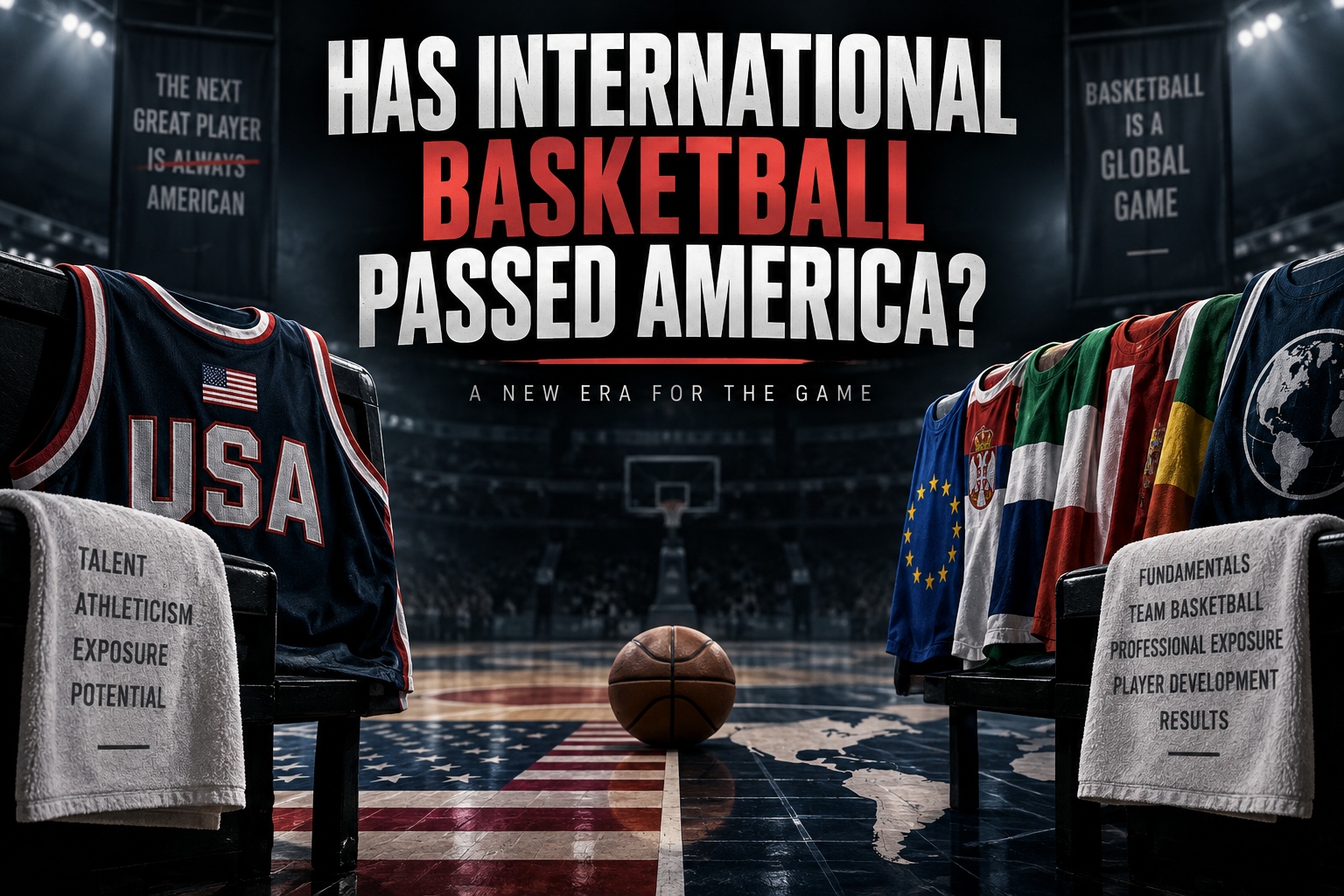
For most of NBA history, if you asked someone to name the best basketball player on the planet, there was a pretty good chance the answer was American. Michael Jordan. Kobe Bryant. LeBron James. Kevin Durant. Stephen Curry. That has changed.
Look at the NBA over the past several years: Giannis Antetokounmpo, Nikola Jokić, Joel Embiid, Shai Gilgeous-Alexander, Luka Dončić and Victor Wembanyama. Since James Harden won MVP in 2018, an American-born player hasn’t won the award. Giannis won twice, Jokić three times, Embiid once and SGA twice. America still produces an incredible amount of talent, but the very top of basketball has increasingly become international. So what changed?
Developing Players Instead of Prospects
American youth basketball has become an enormous ecosystem of AAU tournaments, rankings, recruiting, showcases and highlight videos. There are plenty of benefits to that system, especially the competition and exposure young players receive, but exposure and development aren’t necessarily the same thing.
International systems often place greater emphasis on learning organized basketball from a young age. Players learn how to read defenses, cut without the ball, operate pick-and-rolls, understand spacing and make the extra pass. Those things aren’t always going viral on social media, but they win basketball games.
Jokić is the perfect example. He doesn’t dominate because he’s faster or more explosive than everyone else. He dominates because he’s constantly thinking one step ahead. International basketball isn’t producing better athletes than America. It’s producing some incredibly complete basketball players.
Stop Putting Big Men in a Box
The development of big men might be the clearest example. For years, an extremely tall young player could immediately be told to stay inside, rebound, block shots and post up. International basketball has been much more willing to let big players develop every skill.
Jokić became one of the greatest passers ever. Giannis can grab a rebound and run the offense. Embiid developed a perimeter game. Wembanyama is 7-foot-4 while shooting, dribbling, passing and attacking from the perimeter. Instead of asking what a seven-footer should do, perhaps coaches should simply ask: What can this basketball player learn to do?
Throw Them Into the Fire
I also think the American system can sometimes coddle elite prospects too much. If you’re one of America’s best teenagers, you can become the centerpiece of your high-school and AAU teams. Everyone knows your ranking, everyone knows where you’re being recruited and entire offenses can be designed around showcasing your talent.
Some international prospects experience something completely different. Luka Dončić was playing professional basketball for Real Madrid at 16 years old. Not against other elite teenagers. Against grown men. Those veterans didn’t care that Luka was a future NBA superstar. If he made a bad read, they punished him. If something that worked against teenagers didn’t work against professionals, he had to adjust.
By 18, Luka was EuroLeague MVP. When he eventually reached the NBA, professional basketball wasn’t new to him. The NBA was simply his next professional league. That’s an incredible developmental advantage.
Athleticism Can Hide Weaknesses
America produces ridiculous athletes, but sometimes being overwhelmingly athletic can hide weaknesses while players are young. If you’re faster than everybody at 15, you can recover from mistakes. If you can jump over everybody at 17, you don’t always need perfect footwork or decision-making.
Then you reach the NBA, where everybody is big, everybody is fast and everybody can jump. Now what? Players who have spent years learning spacing, timing, passing and decision-making may be better prepared when pure athletic superiority disappears. International players aren’t inherently smarter; their developmental environments may simply force them to solve difficult basketball problems earlier.
Team USA Can’t Just Walk Through Everybody Anymore
The rise of international basketball isn’t limited to the NBA. We’re seeing it in the Olympics too.
There was a time when America could assemble its best NBA players and expect to overwhelm everyone. The original Dream Team helped establish that image, but international basketball has spent decades closing the gap. Team USA is still the standard, but winning gold is no longer a matter of simply showing up with the most recognizable names.
The 2024 Paris Olympics made that obvious. Team USA brought Steph Curry, LeBron James, Kevin Durant, Joel Embiid and a roster overflowing with NBA talent, yet Serbia nearly knocked them out in the semifinal. The Americans trailed by as many as 17 points before Curry produced one of the greatest performances of his career, scoring 36 points with nine three-pointers in a 95-91 comeback.
Then came France in the gold-medal game. France pulled within three late before Curry buried four three-pointers in the final minutes to put the game away and secure a 98-87 American victory.
America still won gold, and Team USA is still the team everyone wants to beat. But that’s exactly the point: we can’t just dog-walk the rest of the world anymore. Serbia had Jokić. France had Wembanyama. International teams are more talented, skilled and tactically sophisticated than ever.
That loaded American roster needed heroic performances from one of the greatest players in basketball history to survive its final two games.
The gap hasn’t disappeared, but it has gotten a hell of a lot smaller.
America Should Pay Attention
None of this means American basketball is failing. The United States still produces incredible talent, and players such as Anthony Edwards, Cade Cunningham and Cooper Flagg show that American basketball isn’t going anywhere. The rest of the world has simply gotten much better.
For decades, international basketball studied America. Maybe America should steal a few ideas back. Keep AAU, the incredible facilities, trainers and competition, but emphasize fundamentals and team basketball. Let big men develop guard skills. Put elite prospects in uncomfortable situations. Let them fail and play against older competition. Don’t always build the environment around the prospect. Make the prospect learn how to survive the environment.
Because when we look at the very top of basketball today, the trend is impossible to ignore: Giannis. Jokić. Embiid. SGA. Luka. Wemby. Different countries, different styles and different paths, but they may be teaching American basketball the same lesson:
Develop the basketball player first. Everything else comes later.
Liked What You Read?
If you enjoyed this article, like the post and subscribe to Ethical Sports Takes for more NBA debates, rankings and stories from across the sports world.
The NBA has gone global. The question is whether American player development will adapt.
Leave a Reply