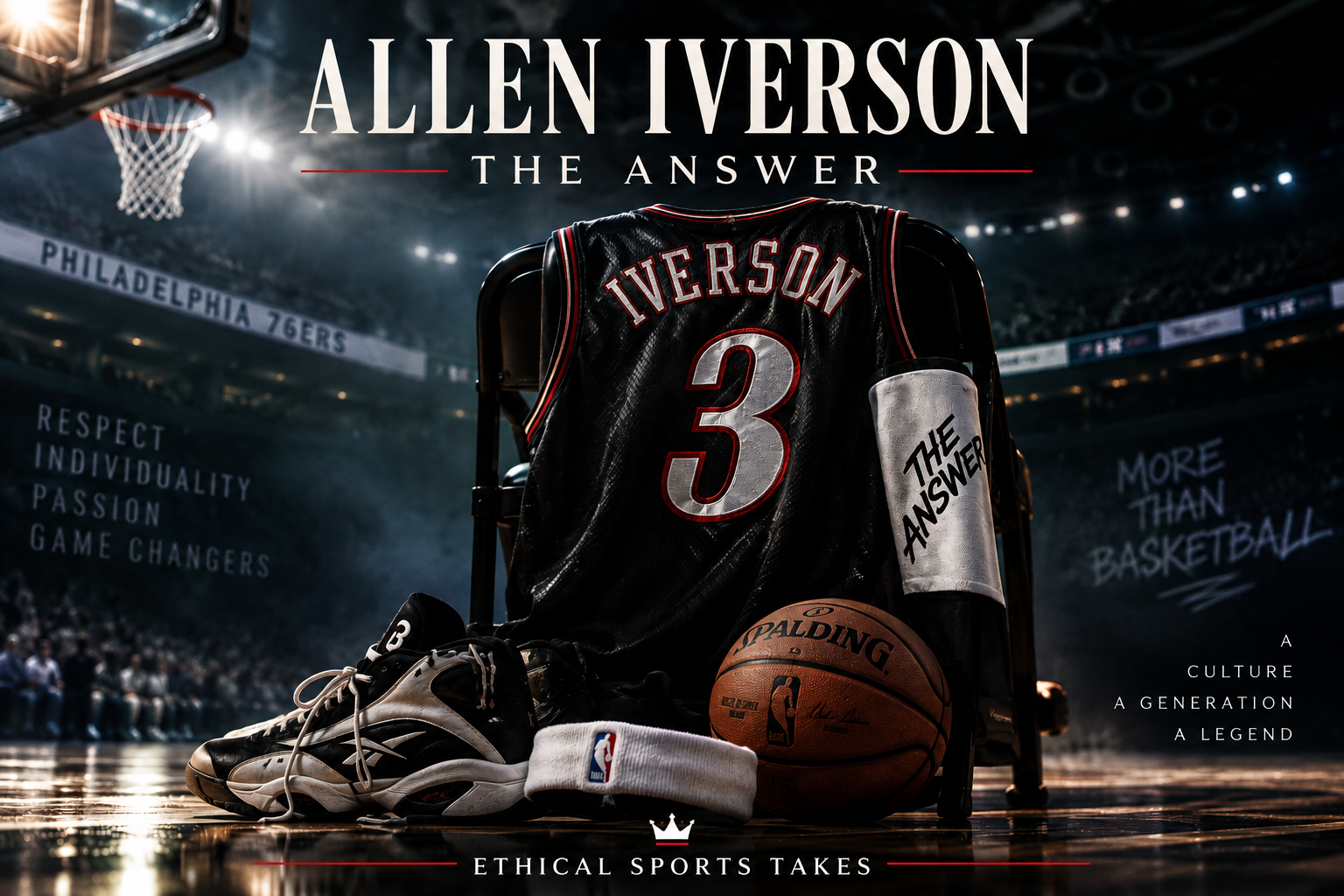
Allen Iverson was much more than The Answer. His basketball résumé alone made him one of the greatest guards ever, but Iverson’s impact went far beyond points, assists and accolades. The cornrows, the headbands, the shooting sleeve, the fashion, the attitude and the individuality all became part of his identity. For an entire generation, Allen Iverson wasn’t simply somebody you watched play basketball. He was somebody people wanted to emulate.
From Hampton to Georgetown
Long before Philadelphia embraced him, Iverson was a phenomenon in Hampton, Virginia, and basketball wasn’t even his only sport. At Bethel High School, Iverson starred in both basketball and football, displaying the ridiculous athleticism that would eventually make a six-foot guard one of the most difficult players in NBA history to contain.
His road to the NBA nearly disappeared before it ever began. Iverson’s involvement in a 1993 bowling-alley altercation resulted in a conviction and prison sentence before Virginia Governor Douglas Wilder granted him clemency after four months. The conviction was later overturned on appeal.
Georgetown head coach John Thompson gave Iverson an opportunity to rebuild his basketball career, and Iverson didn’t waste it. In two seasons at Georgetown, he became one of the best guards in college basketball and led the Hoyas to consecutive NCAA Tournament appearances.
The Answer Arrives
The Philadelphia 76ers selected Iverson with the No. 1 overall pick in the 1996 NBA Draft, and he immediately looked like he belonged. Iverson averaged 23.5 points and 7.5 assists per game as a rookie and won Rookie of the Year.
One moment from that season became bigger than almost anything else. Iverson found himself isolated against Michael Jordan. The rookie crossed over, Jordan reacted, Iverson crossed back and buried the jumper.
It was one possession in a regular-season basketball game, but symbolically it was perfect. A 21-year-old rookie had the greatest basketball player alive standing in front of him and showed absolutely no fear.
That was Allen Iverson.
Pound for Pound
Iverson was officially listed at six feet tall and roughly 165 pounds, but he played like he was twice that size. Night after night, he attacked the paint against players who were considerably bigger and stronger than him. He’d get knocked to the floor, pick himself back up and attack again.
Iverson eventually won four scoring titles, made 11 All-Star teams and earned seven All-NBA selections. His masterpiece came during the 2000–01 season, when he averaged 31.1 points per game, led the league in scoring and steals and was named NBA MVP.
Philadelphia won 56 games and reached the NBA Finals, where Kobe Bryant, Shaquille O’Neal and the defending champion Los Angeles Lakers were waiting. The Lakers entered the Finals having gone 11–0 through the Western Conference playoffs.
Then Allen Iverson walked into Los Angeles.
The Step Over
Game 1 of the 2001 NBA Finals became one of the defining performances of Iverson’s career. He scored 48 points as Philadelphia stunned Los Angeles in overtime, handing the Lakers their first loss of that postseason.
But when people remember that night, one image immediately comes to mind: Tyronn Lue on the floor.
Iverson had been battling Lue throughout the game. Late in overtime, Iverson created space near the corner and knocked down a jumper. Lue fell in front of him. Iverson looked down and simply stepped over him.
Philadelphia ultimately lost the series, but that moment became immortal. More than two decades later, you can show a basketball fan the image of Iverson stepping over Lue and they immediately know what they’re looking at.
Bigger Than Basketball
This is where Iverson’s story separates itself from most basketball legends. His play made him great. His cultural influence made him an icon.
Iverson brought an unapologetic individuality to the NBA. His cornrows became synonymous with him. The shooting sleeve that he initially wore for practical reasons became something players everywhere began copying. His headbands, clothing and overall style were emulated by an entire generation of basketball fans.
Iverson’s connection to hip-hop culture also represented a changing NBA. He didn’t fit the traditional image many people expected from a superstar, nor did he seem particularly interested in changing himself to satisfy those expectations.
In 2005, the NBA introduced a league-wide dress code requiring players to wear business-casual attire in many team and league settings. The rule wasn’t officially created solely because of Iverson, but he became one of the central figures associated with the debate surrounding it.
That alone tells you how influential he had become.
The modern NBA is a league where basketball, fashion, music and individual expression are deeply connected. Iverson wasn’t solely responsible for that transformation, but he was unquestionably one of the players who pushed the league toward it.
His influence can still be seen in generations of players who came after him.
“Practice?”
No Iverson story is complete without one of the most famous press conferences in sports history.
In 2002, while answering questions about missing practices, Iverson repeatedly used the word “practice.” The clip became legendary and has been replayed countless times since.
But the famous soundbite has often overshadowed its context. Iverson was speaking after Philadelphia’s season had ended and was also dealing with personal grief following the death of a close friend. What became one of basketball’s most famous comedic clips came from a much more complicated moment.
It also demonstrated just how enormous Iverson’s presence had become. Almost anything he said or did could become part of popular culture.
The Résumé
For all the discussion about Iverson’s cultural influence, his basketball résumé stands comfortably among the greats:
- 2001 NBA MVP
- 11× NBA All-Star
- 2× NBA All-Star Game MVP
- 7× All-NBA selection
- 3× All-NBA First Team
- 4× NBA scoring champion
- 3× NBA steals leader
- 1997 NBA Rookie of the Year
- 2001 NBA Finals appearance
- 24,368 career regular-season points
- 26.7 career points per game
- No. 3 retired by the Philadelphia 76ers
- Naismith Memorial Basketball Hall of Fame — Class of 2016
- NBA 75th Anniversary Team
For a player who stood roughly six feet tall and weighed around 165 pounds, that résumé is ridiculous.
The Legacy
But statistics and awards still don’t fully explain Allen Iverson.
Remember the crossover on Jordan. Remember the cornrows and shooting sleeve. Remember 48 points against the Lakers. Remember Tyronn Lue lying on the floor as Iverson stepped over him. And remember a six-foot, 165-pound guard repeatedly attacking players who towered over him without showing an ounce of fear.
Allen Iverson proved that a superstar didn’t have to fit somebody else’s image. His influence stretched beyond Philadelphia, beyond basketball and beyond his own generation.
He was called The Answer.
But Allen Iverson became something much bigger.
He became a culture.
What is your favorite Allen Iverson moment? Let us know, and if you enjoyed this edition of Stories of Legends, like the article and subscribe to Ethical Sports Takes for more.
Leave a Reply