We continue our countdown of the five greatest championship runs in NBA history.
At number five, we had the 2017 Golden State Warriors and the Hampton Five, one of the most talented teams ever assembled.
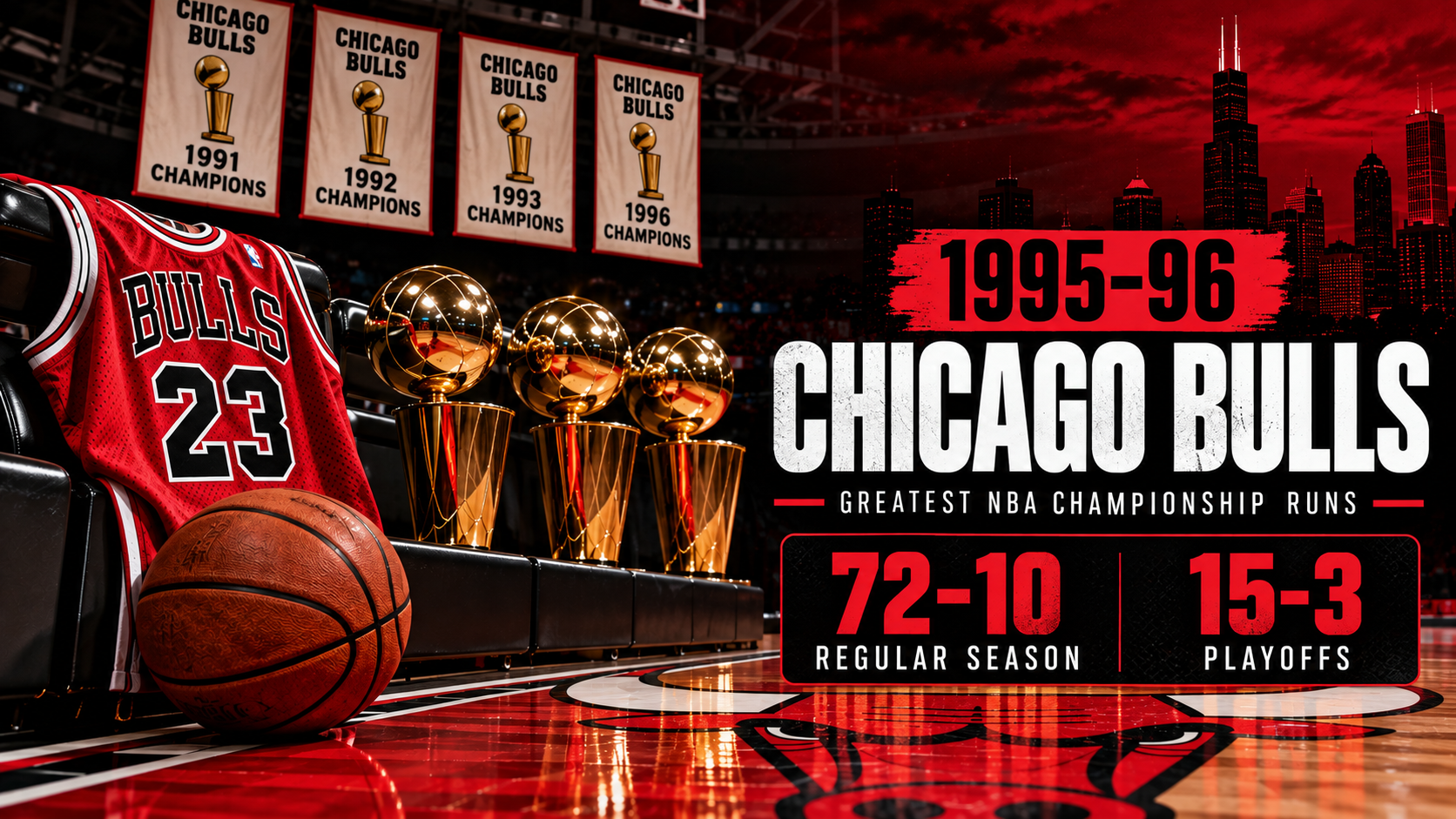
Now at number four, we go back to arguably the most iconic team in NBA history: the 1995–96 Chicago Bulls.
This was Michael Jordan’s first full season after returning from retirement, and he didn’t just return to the top of basketball.
He and the Bulls completely dominated the NBA.
Michael Jordan Is Fully Back
Jordan returned late in the 1994–95 season after nearly two years away from basketball. He was still Michael Jordan, but Chicago’s season ended in disappointment when Shaquille O’Neal, Penny Hardaway and the Orlando Magic eliminated the Bulls in six games in the Eastern Conference Semifinals.
The following season was different.
Jordan had an entire offseason to prepare, Chicago added Dennis Rodman alongside Scottie Pippen, and the Bulls became an absolute machine.
Jordan led the NBA in scoring at 30.4 points per game and won league MVP.
Chicago didn’t just have the best record in basketball.
They went 72–10, breaking the NBA record for regular-season victories that had stood since the 1971–72 Los Angeles Lakers won 69 games.
At the time, no NBA team had ever won 70 games.
The Bulls won 72.
A Record-Breaking Season
Chicago’s 72 victories established a new NBA record and made the Bulls the first team in league history to win 70 games in a season. They also set an NBA record with 33 road victories, finishing an incredible 33–8 away from home.
Jordan made some history of his own. His 30.4 points per game earned him his eighth NBA scoring title, surpassing Wilt Chamberlain’s previous record of seven.
The regular season was historic.
Now Chicago had to finish the job.
First Round: Bulls Sweep the Heat 3–0
Chicago opened its championship run against the Miami Heat, and there wasn’t much suspense.
The Bulls swept Miami 3–0, beginning the postseason exactly as you would expect from a team that had just won 72 regular-season games.
Jordan averaged 30.0 points per game in the series as Chicago quickly moved on to the Eastern Conference Semifinals.
Eastern Conference Semifinals: Bulls Beat the Knicks 4–1
Next came a familiar opponent: the New York Knicks.
The Knicks had battled Chicago throughout the first Bulls three-peat and once again provided a physical test.
Chicago won the first two games before New York took Game 3 at Madison Square Garden.
It would be the Bulls’ only loss of the entire Eastern Conference playoffs.
Chicago responded by winning the next two games and closing out the series 4–1.
Jordan averaged 36.0 points per game in the series, including 46 points in Game 3 and 44 in the decisive Game 5.
Chicago was now eight wins away from another championship.
But first came the matchup everyone had been waiting for.
Eastern Conference Finals: Bulls Sweep the Magic 4–0
This one was personal.
The Orlando Magic were the team that had eliminated Chicago the previous season.
Led by Shaquille O’Neal and Penny Hardaway, Orlando had reached the 1995 NBA Finals and entered this matchup as one of the biggest threats to Chicago in the Eastern Conference.
A year earlier, the Magic had ended Jordan’s comeback season.
In 1996, Chicago gave them absolutely nothing.
The Bulls swept Orlando 4–0.
Chicago won Game 1 by 38 points and never allowed the Magic to truly establish themselves in the series.
Jordan averaged 29.5 points per game, and the Bulls completed their revenge in emphatic fashion.
One year after Shaq and Penny sent Chicago home, Jordan and the Bulls returned the favor without losing a single game.
Chicago entered the NBA Finals with an incredible 11–1 postseason record.
NBA Finals: Bulls Beat the SuperSonics 4–2
Waiting for Chicago in the NBA Finals were Gary Payton, Shawn Kemp and the 64-win Seattle SuperSonics.
Seattle was an elite team in its own right, but Chicago immediately took control of the series.
The Bulls won the first three games to build a commanding 3–0 lead and move within one victory of the championship.
Seattle refused to disappear.
The SuperSonics won Games 4 and 5, forcing the series back to Chicago for Game 6.
But the Bulls weren’t letting this opportunity slip away.
Chicago closed out Seattle in Game 6, winning 87–75 and capturing its fourth NBA championship.
Jordan averaged 27.3 points, 5.3 rebounds and 4.2 assists per game in the Finals and was named Finals MVP.
The championship also completed an incredible individual season for Jordan. He won the NBA MVP, All-Star Game MVP and Finals MVP in the same year.
72–10. 15–3. NBA Champions.
The final numbers tell the story.
72–10 in the regular season.
15–3 in the playoffs.
87–13 overall.
Michael Jordan returned for his first full season and immediately reclaimed his place at the top of basketball. Chicago broke the NBA wins record, lost only once on its way through the Eastern Conference, swept the team that had eliminated it the year before, and defeated a 64-win Seattle team in the NBA Finals.
It was the beginning of Chicago’s second three-peat and one of the most dominant seasons the NBA has ever seen.
The 1995–96 Chicago Bulls are number four on my list of the greatest NBA championship runs of all time.
Three remain.
Like the article and subscribe to Ethical Sports Takes for more NBA content.
Leave a Reply